Tag Archives: NBA

Notes From Warriors-Bucks

Last Saturday night, the Warriors’ 24-game winning streak to open the season was ended, on the road, against the Bucks.

It was a spectacular game. I was cheering for history, and I never gave up hope until the Warriors were down eleven with ninety seconds to go. How could I? Golden State’s smothering defense can force turnovers and Steph Curry can rain threes, erasing even a double-digit lead in a minute or two.

The atmosphere at the game was electric. That phrase is overused, but in this case, it’s completely true. It’s only December, but the fans were cheering like it was a Game 7. The Bucks even handed out shirts reading “24-1” on the front.

Greg Monroe was impossible to defend. The Warriors couldn’t go to the so-called Death Lineup (or as Curry calls it, the “Uh-Oh Lineup) thanks to Monroe’s punishing post-up game. He pushed through defenders all-game, throwing in lefty layups and floaters on his way to 28 points on a mere sixteen shots.

Giannis Antetokounmpo was unstoppable as well. Despite taking only 11% of his team’s shots, the Greek Freak was a force all game, compiling eleven points, twelve rebounds, and ten assists for a triple-double.

Even Michael Carter-Williams managed to put his shooting woes behind him, shooting seven out of ten from the field and scoring seventeen points. He played tenacious defense, racking up five steals, resulting in fast-break chances for easy points.

Most impressively for the Bucks was the poor shooting night they inflicted on Curry. The early favorite for MVP shot only ten of twenty-one from the field, including an awful two of eight from three-point range.

This inefficiency was not limited to Curry. The team as a whole only shot 40.9% from the field and 23.1% from three. The Warriors even managed to miss eight free throws.

Some people have decided that Milwaukee has managed to figure out the formula to beating Golden State. Let’s work through that formula together to see one, if it has any basis in fact, and two, if it will work in the playoffs.

First, this game was in Milwaukee. Assuming Golden State earns home-court advantage throughout the playoffs, an opponent will have to win in Oracle Arena to eliminate the Warriors.

Next, this game was a back-to-back for the Warriors, which contributed to their lackadaisical play early on. In the playoffs, there are no back-to-backs.

On top of that, Golden State’s game the night before was a double-overtime game in Boston. The Warriors’ best two players, Curry and Draymond Green, played an exhausting 47 and 50 minutes, respectively. After the draining game against the Celtics, the Warriors flew to Milwaukee, arriving at their hotel at around 3:00 AM.

Finally, Harrison Barnes, the starter at small forward and the fifth member of the Lineup of Death (alongside Curry, Green, Klay Thompson, and Andre Iguodala), sat out his eighth straight game due to a sprained left ankle.

To recap, the formula to beating the Warriors is to play them at home, after they played a double-overtime game the night before and got to their hotel at three in the morning, have one of their starters out with an injury, and force the best shooter in NBA history and his team into an uncharacteristic poor shooting night.

Sounds pretty easy to replicate. The Warriors are doomed.

Notes From Knicks-Sixers

Last night, I watched the sloppy Sixers-Knicks game in its entirety. Here are a few observations from the game.

First off, the viewing experience of watching the Knicks on MSG is made five times as enjoyable thanks to Walt Frazier’s entertaining phrasing. According to this article from ESPN, Frazier acquired his massive vocabulary by reading the New York Times’ Sunday Arts & Leisure section and writing down whatever words that caught his eye. After he wrote down the words, Frazier then studied how each was used in a sentence using a method he calls “linking and thinking.”

Anyways, last night, Frazier produced a few classics in “shaking and baking,” “wheeling and dealing,” and “moving and grooving” before moving on to more eclectic ones, such as “swooping and hooping,” “hanging and banging,” and “slamming and jamming.”

Carmelo Anthony looked awful last night. Even in a game against the sorry Sixers, he’s just been off. Anthony missed layups and chucked up badly off-target three-pointers. He finished with twelve points off of sixteen inefficient shots in a subpar game. I don’t know if this is a trend (I sure hope not), but it’s something to keep an eye on as the season progresses.

In last year’s draft, Nik Stauskas, a shooting guard, was taken by the Kings 8th overall. He started exactly one game for them, the season finale against the Lakers. Over the summer, Sacramento traded him to Philadelphia in a salary dump so they could open up extra cap space to sign the eight superstars who were all lining up to come play for the Kings.

Putting aside the hilariously lopsided deal, that put Stauskas in Philadelphia, on a team that didn’t care about winning whatsoever. The trade allowed him to play more minutes which would give him a larger opportunity to work through whatever issues he’d dealt with in his rookie season. Accordingly, his playing time has increased by nine minutes per game.

He didn’t have a big game or anything last night, with four shot attempts over twenty-four minutes, but one thing I noticed was his lightning-quick release on his three-point jumper. It was almost Curry-esque.

Last of all, let’s talk about Young Kristaps, who put up seventeen points, ten rebounds, and four blocks over thirty minutes in a customarily spectacular game.

http://www.youtube.com/watch?v=UNWqhxNV-Yk

Despite his height, Young Kristaps has a lovely jumper he used twice from three-point range, nailing both shots. Nothing about his shot seems forced; it’s natural and he’s able to smoothly catch the ball and rise up for a graceful shot.

Young Kristaps had a couple of impressive passes last night. Early in the game, he reached around his defender to deliver a nice pass to Robin Lopez for a layup. Later on, Jose Calderon and Young Kristaps ran a pick-and-roll. Calderon passed it to Young Kristaps as he came around the screen, and Young Kristaps started to drive towards the basket, but instead hit Calderon with a behind-the-back pass. He had another fine pass to Calderon where he spotted that the point guard had a step on his defender and lofted the ball over to him for an easy layup.

I can’t believe we’ve gotten this far into the article without mentioning a single one of Young Kristaps’ thunderous dunks. He had one where he drove lefty into the lane on Nerlens Noel and rose up for a tomahawk slam and another where Derrick Williams lobbed the ball up to him from behind the three-point line for a monstrous alley-oop.

Young Kristaps blocked four shots last night, but we’ll focus in on one. In the middle of the opening quarter, Isaiah Canaan drove to the basket with Young Kristaps moving along with him. Now, one of the concerns about Young Kristaps before the draft was that he was too thin to survive in the NBA. Although that’ll go away as he gets older, it was a problem in this case as, on his way to the rim, the 6’0″ Canaan rammed into the chest of the 7’3″ Young Kristaps, pushing him back. Despite this, Young Kristaps’ arms are some long enough that he was able to envelope Canaan, blocking the shot with ease.

Along with collecting four blocks, Young Kristaps picked up only one foul. This is a marked departure from Summer League, where across four games and 82 minutes, he picked up seventeen fouls, including a game with seven fouls in only 22 minutes. Working on his trouble with fouling was a high priority for Young Kristaps entering the season.

The problem was that Young Kristaps was often committing fouls due to his aggressiveness on defense. To measure the worth of his aggressiveness on defense, I used Young Kristaps’ SB/F (steals+blocks/fouls), a new statistic I made up to measure whether or not a player’s tenacity on defense is a positive, was a .647 during Summer League. So far this season, he’s improved it to a .881.

Using statistics from basketball-reference.com, there have been 276 games played so far this season, with roughly 2208 steals, 1435 blocks, and 5741 personal fouls across all 276 games. That works out to a league-average SB/F of .634, so, to my surprise, apparently Young Kristaps was roughly average during Summer League and has been exceptional so far this year.

Now that Young Kristaps can play aggressive defense while still staying on the floor, that combination, along with all of his other talents, makes it look like he’ll be a star.

Thanks to Young Kristaps, for the first time in a decade, Knicks fans, there’s a reason for hope.

I noticed I wrote “Young Kristaps” a lot this article, so here’s a quick explanation for why I call him that, rather than Porzingis. In the 2015 NBA Draft Diary, I wrote:

Screen Shot 2015-12-03 at 7.20.14 PM

That’s it. Maybe as a compromise with myself I’ll alternate Young Kristaps with YK. I guess we’ll figure it out.

Super-duper quick pick for Thursday Night Football: Detroit +2 over Green Bay. Neither team makes me feel any good about betting on them, but Detroit’s been playing better lately so that’s as good a reason as any.

Welcome to the Suck Bowl

The NFL has the Super Bowl. The NCAA has countless bowls, covering an eclectic array of classics like the Cotton, Orange, and Rose, and shameless advertisements including the GoDaddy, Hyundai Sun, and Nova Home Loans Arizona. The NBA? Well, it has the Suck Bowl.

Tonight in Philadelphia, two team with a combined record of 2-32 will square off. In one corner, there are the Lakers, whose Stone-Age coach’s stubborn dismissal of common sense has them at 2-14. In the other, there are the Sixers, whose New-Age general manager’s continued plea to “trust the process” has the team at a dismal 0-18.

These are two teams heading in similar directions, but it’s always intriguing to map out how each got to where they are.

Let’s begin with the Lakers, a team that is dysfunctional enough that it allows Kobe Bryant to airball at least four shots a game and whose coach, Byron Scott, recently said: “Our guys get along. They just don’t trust each other”. And no, I’m not sure how that makes any sense, but remember, this is the same guy who seemingly believes that two and three are equal, based on his insistence that his team not shoot too many threes.

Anyways, way back in 2012, the team traded for stars Steve Nash and Dwight Howard. The team was expected to be great; however, Mitch Kupchak, the team’s general manager, apparently forgot that defense is as important as offense en route to a disappointing 45-37 season.

Despite their final record, the Lakers were still in the playoffs as the seventh seed, so there was still hope for their season. Then they got whipped by the Spurs by an average scoring margin of 18.75 over a four game sweep.

In the offseason, Howard fled to Houston, ending the team’s hope that he would be its bridge from Bryant into the future. Instead, the Lakers extended Bryant’s contract by two years for 48.5 million dollars, condemning the team to mediocrity or worse for the foreseeable future.

The next season, Los Angeles went 27-55 and Bryant played in a mere six games due to injury. There was a bright side to the team’s awfulness: a high draft pick resulting in Julius Randle, a power forward out of Kentucky. In addition to Randle, the Lakers nabbed Jordan Clarkson, a guard, at 46th overall.

In the 2014-15 season, the Lakers went 21-61, the franchise’s worst record throughout its entire history. Adding to the dismal display, Randle broke his leg in his NBA debut, immediately ending his season, and Bryant again suffered through various injuries, playing only 35 games. However, Clarkson had a sparkling rookie season, excelling in March and April once he received playing time, with averages of 17 points, 4.7 rebounds, and 5.7 assists over the last two months of the season.

Another ugly season led to another high draft pick, and with the help of some luck in the lottery, the Lakers were able to draft D’Angelo Russell, a star point guard, at #2 overall.

That’s where the team stands. It’s got an aging star who’s not a star any more (and is retiring after the season) and a couple of young studs. The team sits at an ugly 2-14, but there’s plenty of hope for the future.

In Philadelphia, there’s also hope, but the team took a far different path to get it.

The story of the present-day 76ers team began in 2013, when Sam Hinkie tore down the team to tank for a high draft pick. The team finished 19-63, but only got the third pick in the draft, with which they took Joel Embiid. Later on in the first round, the Sixers traded its 10th overall pick to Orlando for the 12th pick and a 2017 first rounder (which led to some hilarious awkwardness as I discussed here), and selected Dario Saric, who can’t come to the US until at least 2016.

After another horrific season at 18-64, the Sixers again had the third overall pick, and again took a big man, this time taking Jahlil Okafor out of Duke.

As Philadelphia stands now, it has a ton of solid players on its roster, from Nerlens Noel to Robert Covington to TJ McConnell to Nik Stauskas to Tony Wroten to Isaiah Canaan to Jerami Grant. It has a wealth of future draft assets (as Business Insider details here). It even has a couple of 2014 first-rounders coming in the future when Embiid finally makes his debut and Saric comes over from Turkey.

It’s clear that Hinkie is pushing all his assets into the future while imploring the team’s fans to “trust the process” and, despite the agonizing state of the present-day team, the plan is nearly guaranteed to work. Zach Lowe wrote over the summer that “if Philly is really willing to do this for five, six, or seven seasons, it almost cannot fail. It will either land a superstar or draft so many good players that they will gather a solid NBA team.”

Until that glorious future, however, Sixers fans are stuck with the current team. Despite its numerous quality players, it’s winless at 0-18. The team isn’t as bad as it record shows, though, as Philadelphia has had a lead in the fourth quarter of each of its last five games, only to fritter it away, resulting in agonizing loss after agonizing loss.

Tonight’s game against the Lakers is especially important, because, if the Sixers lose, they’ll set a record for the worst start to a season in NBA history. Luckily, Philadelphia is favored by 1.5 points, but if they lose again tonight, another shot at a victory may not come for a while.

Will the Sixers Win Before the Warriors Lose?

According to ESPN’s Basketball Power Index, the Warriors are favored in 65 out of their remaining 67 games. The only two games the Warriors are the underdogs in are its road games at San Antonio. That’s it.

The first of those two games is in the middle of March, the Warriors’ 68th game of the season. Now, Golden State will almost certainly lose before then, but the question is: When?

The Warriors don’t face a tough game until December 5th, the team’s 21st game of the season, when they’ll play the Raptors on the road. Even then, they’ll still be heavy favorites against a Toronto team that just lost Jonas Valanciunas to a hand injury.

It’s worthwhile to note that the Raptors gave the Warriors a serious scare when the teams last played, on November 17th. In that game, at Oracle Arena, the visitors barely lost by a score of 115-110.

Assuming Golden State gets past Toronto, the toughest game the team will face until Christmas is a road matchup with the Pacers. On Christmas Day, the Warriors will host the Cavs, which could be a challenging matchup. However, due to the league’s best home-court advantage, Golden State is still likely to cruise to a victory.

We need to fast-forward almost a month, to January 18th, for the next serious threat to Golden State’s perfect record. They’ll play Cleveland on the road to begin an imposing weeklong stretch that includes road games in Chicago and Indiana and a home game against San Antonio.

If I had to bet, I would guess that the Warriors lose their first game of the season during that stretch, between January 18th and 25th. I have to agree with ESPN: the Warriors don’t look like they’ll be losing any time soon.

However, although the Warriors have been dominant through the first month of the season, they still have a close competitor in making history and it’s not who you might think.

The 76ers are almost as bad as the Warriors are good, with an 0-15 mark to start off the season. They’re four losses away from passing the atrocious 2009-10 Nets for the worst start in NBA history. This could be the most riveting storyline of the next month or two: will the Sixers win before the Warriors lose?

Now that’s a far more compelling question. The next good chance Philadelphia has for a win is in a week, when they’ll play the Lakers at home on December 1st. However, if they can’t end the streak then, they’ll only have one quality shot at a victory in the next month, when they play Brooklyn in the Barclays Center on December 10th.

After that, the next solid opportunity the Sixers will have for a win is a couple of road games against the Kings and Lakers on December 30th and January 1st, respectively. If Philadelphia still doesn’t have a victory after that, well, they’ll have to wait more than a month for another winnable game, when they host the Nets on February 6th.

I think the losing streak will end against the Lakers next week. It’ll actually be quite dramatic. Assuming the Sixers lose their next three games, they’ll sit at 0-18 heading into the game. To avoid the ignominious accomplishment of owning the worst start in NBA history, that Lakers game will be a must win.

To answer the original question, it seems as though the scheduling gods want Philadelphia to win before Golden State loses. However, if the Sixers keep on losing and the Warriors keep on winning, each team setting a new record each and every game, an amazing game will be set for January 30th.

On that date, the Sixers could be 0-45 and the Warriors could be 46-0 when the two teams meet for the first time this season for a game in Philadelphia. Although the odds are a million to one against it, if Philadelphia managed to get its first win by handing Golden State its first loss, well, that would just be awesome.

Can Anyone Stop the Warriors?

As Golden State nears a record-breaking 16-0 start to the season, it’s time to ask: Can anyone stop the Warriors?

In last night’s game against the Nuggets, the Warriors went to their super-small lineup. According to NBA.com, in two minutes, that lineup scored fourteen points. So, yeah, that’s pretty unstoppable.

That lineup consists of Stephen Curry, Klay Thompson, Harrison Barnes, Andre Iguodala, and Draymond Green and it’s unstoppable. All five players are capable three-point shooters, creating pristine spacing that they then take advantage of thanks to their unselfish passing. That’s what makes the Warriors so impossible to guard, and that’s how they’re able to score fourteen points in a mere two minutes.

However, many other teams could put out these sorts of lineups with five three-point shooters sharing the floor at once. What makes the Warriors unique is that they’re able to play five three-point shooters while surviving on defense.

How are they able to do this? Well, Green is the linchpin of the defense. Despite being only 6’7″, Green is capable of playing center. Without him, the rest of the scheme wouldn’t work at all.

Outside of Green, this lineup’s success stems from its incredible flexibility as all five of its members are between 6’3″ (Curry) and 6’8″ (Barnes). This similarity in size allows the team to switch at will, closing out on three point shooters, rotating around the floor to prevent drives to the basket, and being a whirring machine of defensive mayhem.

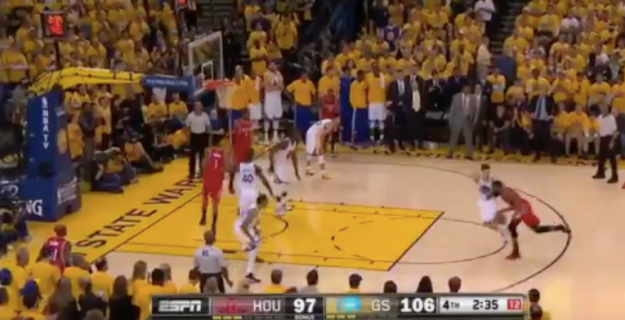
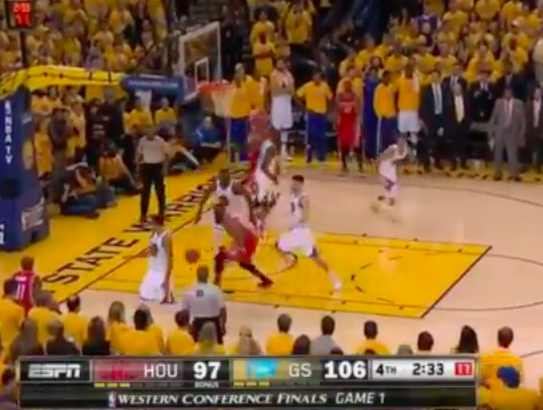
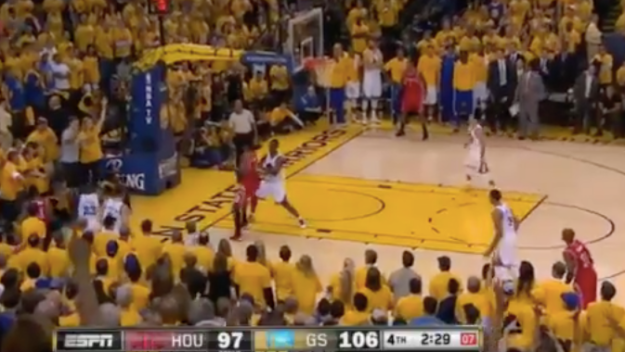
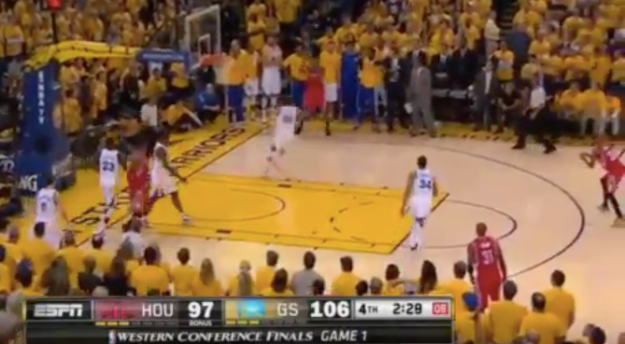
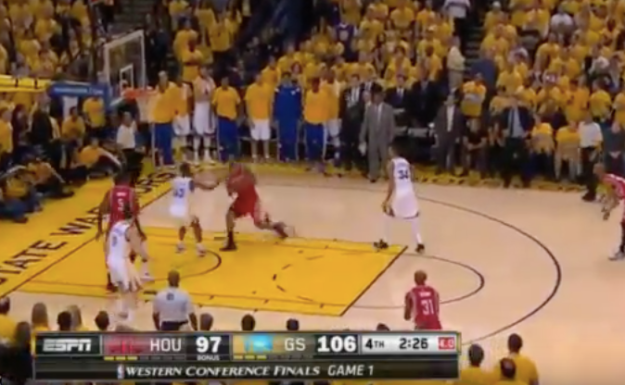
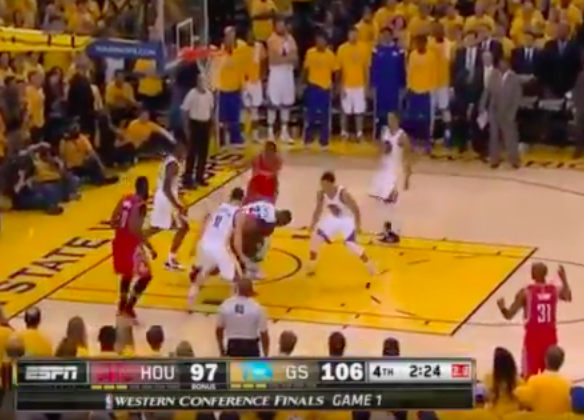
So many conversations concerning Golden State are about its offense, so to be contrarian we’ll focus on its defense. Let’s break down one crunch-time possession from Game 1 of last year’s Western Conference Finals that exhibits the system played to perfection, with Shaun Livingston in place of Andre Iguodala.

Screen Shot 2015-11-23 at 5.30.38 PM

With twelve seconds left on the shot clock, James Harden drives down the middle of the floor against Thompson. Notice how all possible passing lanes are walled off.

Screen Shot 2015-11-23 at 5.38.27 PM

Next, the ball gets poked away and Thompson and Green converge on Harden, trapping him in the corner. Barnes shifts off of Trevor Ariza in the opposite corner to guard Josh Smith next to the basket.

Screen Shot 2015-11-23 at 5.32.21 PM

Harden manages to pass it out of the double-team, into the middle of the floor, creating a momentary four-on-three advantage for the Rockets. However, while against a lesser team, Smith would have been left open in the middle, against the Warriors, Barnes is already there, stopping him from getting an easy shot off.

Screen Shot 2015-11-23 at 5.32.46 PM

Smith passes it out to Ariza in the corner, but Curry switches onto him, closing off a clear path to the rim. Livingston leaves Jason Terry (#31) alone to cover Curry’s man, Corey Brewer.

Screen Shot 2015-11-23 at 5.33.04 PM

Ariza drives to the rim, Curry hot on his tail, but Barnes is at the rim to meet him. The shot clock is down to four seconds, which pressures Ariza to attempt a shot. At this point, Terry is open, but if Ariza managed to somehow thread a pass through across the floor while in mid-air, Thompson would be able to close out on him.

Screen Shot 2015-11-23 at 5.33.46 PM

Ariza then fumbles the ball away and the Warriors close in. The ball gets knocked out of bounds and the Warriors get the turnover.

Just in the last twelve seconds of this possession, the Warriors are able to snuff out four threats (plus countless potential ones) by switching seamlessly.

It’s plays like these that great defenses excel at, all five players switching in unison, playing ferocious defense while still remaining under control. There’s nothing the Rockets could do to penetrate the swarming defense of the Warriors.

Even in the team’s starting lineup, with Andrew Bogut at center and Iguodala on the bench, the loss of some flexibility doesn’t prevent Golden State from keeping up the elite defense that was the best in the league last season by points per possession.

So far this year, Golden State has slipped all the way down to fifth in points per possession, and its offense is the best in the league, scoring 111.8 points per 100 possessions.

When a defense like this is paired with the best shooter in NBA history and a roster full of players who complement him perfectly, it’s hard to imagine the Golden State Warriors being beaten any time soon.

Catching Up on the NBA

My picks are already looking awful. Anthony Davis and Bradley Beal have been hurt. The Pelicans have been plagued by injuries. Washington has been average at best. Without Corey Brewer’s miracle three-point attempt to send last night’s game to overtime, the Rockets would be an atrocious 4-8. Nothing at all has been working out as planned so far.

Well, almost nothing. The Warriors have been customarily dominant. If you follow basketball at all, I’m sure you’ve seen amazing stats lauding the team for their historic achievements, but here’s one you probably haven’t heard: the Warriors are currently on pace to go 82-0, shattering the 72-10 mark set by the 1995-96 Bulls.

All jokes aside, Steph Curry has been insane. I’ve watched a few of Golden State’s games so far, and every time he takes a shot, it seems to be almost a technicality when it goes in. A couple of weeks ago, the Warriors were down to the Clippers late in the game, and Curry just took over and Los Angeles couldn’t do anything to stop him.

Curry’s the clear frontrunner for MVP at this point and he’s way ahead of the pack. Who can challenge him? LeBron is resting for the playoffs, Davis has been hurt, John Wall hasn’t been great, Kevin Durant has been hurt, and James Harden has been an inconsistent player on an inconsistent team. Blake Griffin and Russell Westbrook are my 2-3 behind Curry, but who’s next? Honestly, it might be Andre Drummond. That’s just weird.

In other news: Young Kristaps is everyone’s new favorite player. Young Kristaps has been surprisingly great so far for the Knicks. For all the talk about how he’s a project and how he’s a year or two away, he’s been really really good. Earlier this week, he put up a 29-11 double-double on an efficient 17 shots. He’s been able to shoot threes effectively (including an almost game-winner against Charlotte that was just after time expired) while being a force down low. He’s thrown down a few monstrous put-back dunks (including this beauty against the Raptors) and has been able to serve both as a stretch-four when on the court with Robin Lopez and as a more conventional big man when playing alone.

I think it’s hilarious what’s been happening in Brooklyn so far this season. They’re absolutely, unequivocally atrocious and seem OK with it. That’s a perfectly reasonable thing to do. After all, tanking has worked in the past and the Sixers have been happy to lose again and again over the past few years in the hopes of landing a franchise player. However, the so-called “brain-trust” in Brooklyn seems to have forgotten one important detail: They don’t own their own pick. So while Brooklyn’s incessant losing will likely result in the acquisition of a franchise player, that franchise player will be heading to Boston as part of the Pierce-Garnett-Terry trade from a couple of years ago. While we’re here, I can’t get over how lopsided that trade was. Exploring the ramifications of that horrendous trade might be worth an article in the near future.

Anyways, as we can see, the NBA isn’t lacking in storylines. We haven’t talked at all about the competitive Rookie of the Year race or the exciting young teams coalescing in Orlando and Minnesota or Kobe Bryant’s quest to miss the most shots in the history of the NBA. We’ll discuss all of this, and more, in the future, but for now, let’s just enjoy the impending bloodbath between the Warriors and Clippers on national TV tonight.

The 2015 NBA Draft Diary

Hello all, and welcome to the 2015 NBA Draft Diary. This is our second straight year recording the draft in this format (here’s last year’s: https://sushionsports.wordpress.com/2014/06/27/the-2014-nba-draft-diary/) and it should be as great as the last one.

Although I doubt this draft will reach last year’s hilarious high when Zach LaVine couldn’t hide his dismay at having to play for Minnesota, there’s a similar amount of doubt about what will happen.

Last year, no one knew what was going to happen at the top between Andrew Wiggins, Jabari Parker, and Joel Embiid. This year, Karl-Anthony Towns is the consensus number one pick, but the next few picks are muddled.

The Lakers are able to dictate what will happen for the rest of the draft from their perch at number two. They get to choose between a wealth of talented players; Jahlil Okafor, D’Angelo Russell. and Kristaps Porzingis are all options at their pick.

Philadelphia, at number three, could be trapped if the Lakers take Russell. That’d leave them with a choice between the two big men, Okafor and Porzingis, when they already have Nerlens Noel and Embiid, or reaching a little to address a need.

The Knicks, at number four, are hoping that Russell drops to them, as he’s a good fit for Phil Jackson’s fabled triangle offense. Of course, Isiah Thomas has talked about trading the pick for a veteran in a win-now move. Wait, did I say Isiah Thomas? Whoops, I meant Phil Jackson, although it’s easy to get the two confused, especially if Jackson trades away this pick. Let’s hope he doesn’t make that trade for the sake of all the scarred Knicks fans at the Barclays Center tonight.

The most important quality teams are looking for in this draft is positional flexibility, meaning that they want a player who can defend multiple positions on the defensive end. Why is this? Well, the Warriors just won the NBA title in part because of a switching machine on defense. Draymond Green is getting a max contract this summer in part because he can defend all five positions credibly. Justice Winslow, a wing, and Willie Cauley-Stein, a big man, are both highly ranked players who can defend multiple positions at elite levels, particularly Cauley-Stein.

My personal favorite player this draft is Frank Kaminsky. To me, he seems to be exactly what NBA teams are looking for nowadays, big men who can shoot threes, run the floor, and play decent defense. Kaminsky can be one of the first ever stretch-5s.

There’s one important domino yet to fall: DeMarcus Cousins. His screwed-up team, the Kings, and its screwed-up owner, Vivek Ranadive, are considering firing George Karl four months after they hired him. If they trade Cousins, either because they side with Karl against him or because he gets fed up enough with their BS that he finally demands a trade.

Anyways, the draft is about to start, so let’s end this bloated introduction and begin!

7:35: Adam Silver opens up with the same type of speech that he gave last year, going through the reigning champions and where players integral to their team were drafted.

7:39: As expected, Towns is selected first overall.

7:39: Now the real intrigue begins. As we discussed earlier, what the Lakers do here will set the tone for the rest of the draft.

7:40: Apparently the Timberwolves are the first team to ever have three consecutive first overall picks on their team, with Anthony Bennett, Andrew Wiggins, and now Towns.

7:41: In its congratulations to Towns on its Twitter, Kentucky used this hashtag: #succeedandproceed. Calipari definitely isn’t shy about his team-building strategy.

7:45: The Lakers take…

7:46: D’Angelo Russell.

7:46: Can’t quibble with that pick. Okafor is the most NBA-ready player in the draft, with a developed post-up game, but the Lakers already have an elite post-up threat down low in Julius Randle. Also, if they took a defensive sieve in Okafor, along with creaky old Bryant and Randle, they might somehow be worse at defense than they were last year. Taking Russell also allows the Lakers to shift Jordan Clarkson out of the starting lineup into a role as a sixth man where he’ll be valuable instant offense off the bench. Russell just works better for the Lakers on so many levels.

7:50: Also, thinking more about Okafor, the Lakers could just look across their stadium at the Clippers. DeAndre Jordan was unplayable for swaths of time in the playoffs because he couldn’t shoot free throws. Okafor, while not as bad as Jordan, is still only a 51% free throw shooter, making him a liability. To me, that’s significant enough of a risk that it’s tough to look past it, especially because Jordan is an elite defensive center while Okafor, well, is not. Because of this, it wouldn’t be as surprising as it might otherwise be if he dropped a little in the draft.

7:52: Conspiracy Theory Alert: Maybe the Lakers didn’t take Okafor because they have a wink-wink agreement with Kevin Love to come to Los Angeles and won’t have a starting spot for Okafor.

7:53: Philadelphia’s pick is in. Let’s see what Sam Hinkie does…

7:55: Okafor.

7:55: There are a couple of ways to spin this: either Hinkie is seriously worried about Embiid and decided that he needed another big man, or he’s just sticking to his overall strategy of taking the best player available, believing that talent will work itself out in the end.

7:56: In the crowd, a Sixers fan was holding up a sign, reading “#trusttheprocess”. At this point, that’s really the only thing Philly fans can do, but that’s depressing nonetheless.

7:58: I guess Okafor’s woes on the defensive end could be less glaring when playing next to the defensive force named Nerlens Noel. That’s a bright side, I guess.

7:59: Ooh! Just thought of another positive: Okafor’s poor free throw shooting won’t become a serious problem in the playoffs because the Sixers won’t make the playoffs any time soon.

8:00: Jalen Rose’s team needs for the Knicks is “Everything”. Ugh.

8:02: The Knicks take Porzingis.

8:02: Some Knicks fans in the crowd appear to be pleased but most seem extremely upset.

8:03: C’mon Knicks fans, look on the bright side: At least Jackson didn’t trade the pick. That’s a positive, isn’t it?

8:05: This pick is risky, obviously, because they’re taking a foreign player, but more importantly, it’s just a really bad fit. Carmelo Anthony is most valuable at power forward but Porzingis’ natural position is at the 4.

8:10: Orlando takes Mario Hezonjav, another Eastern European, fifth overall.

8:11: Another risky pick and another bad fit. Hezonja is a shooting guard, but they’ve already got Victor Oladipo, an established player who’s still young and getting better, at that position. It just doesn’t seem worth it to me. I would have rather seen them go with Justise Winslow here, as their only weak spot in their starting lineup right now is at small forward and teams can always use an elite defender, particularly when that player can defend multiple positions.

8:17: Willie Cauley-Stein to Sacramento at sixth overall. Interesting pick. Cauley-Stein is a center, just like Cousins, but at least he’s flexible and an amazing defender, making him a fit pretty much anywhere. Still, it’s curious that they’d pick him when it might offend Cousins enough that he’d insist on being traded.

8:24: Another interesting pick as the Nuggets select Emmanuel Mudiay with the seventh pick.

8:25: My favorite thing about Mudiay is that he realized that the NCAA is corrupt and unfair and blew them off to go play in China while getting paid for his services. Hopefully more players will follow his lead instead of playing for free in the NCAA.

8:27: By taking Mudiay, Denver is saying, quite clearly, that it’s done with Ty Lawson, its star point guard. He’s been on the trading block for months, and is now almost certainly going to be traded before too long.

8:29: Stanley Johnson is taken by the Pistons eight overall. He should be a nice fit at small forward, playing on the wing next to Kentavious Caldwell-Pope, shooting threes off passes from Brandon Jennings.

8:36: This is somewhat ominous for Charlotte. Last year they also had the ninth pick and the player they drafted, Noah Vonleh, has already been traded away.

8:37: The Hornets take…

8:37: FRANK THE TANK!!!!

8:41: I actually really don’t like this pick for Charlotte. They’ve already got Al Jefferson at center, who, while oft injured, is still a force on the offensive end. Kaminsky is going to be forced to play power forward, but that negates one of his biggest assets: his ability to shoot threes while being able to play center defensively. It’s a poor fit and this poor fit might submarine Kaminsky’s career

8:42: Rose makes the good point that the Hornets just traded for Spencer Hawes, another guy who can play center and shoot threes, while trading away Lance Stephenson, who’s an elite defender, to get him. Then, in the draft, they turn around and draft someone who can play center and shoot threes, in Frank Kaminsky, while passing on an elite defender, in Justise Winslow. Not a good sign as to the quality of Charlotte’s brain trust.

8:43: And the Heat take Winslow tenth.

8:44: It’s a good pick because, as I’ve repeated again and again, when you’re taking a guy like Winslow, it’s never a bad pick. It’s really that simple.

8:50: The Pacers select Myles Turner eleventh overall.

8:52: This pick is intriguing because it signals that Indiana is moving away from Roy Hibbert and the grinding defensive mentality that they’ve relied on for years.

8:53: Apparently, Turner can hit threes, another harbinger of offensive change for the Pacers.

8:57: The Jazz take Trey Lyles, the third Kentucky player picked today.

9:00: Here’s my problem with this pick: Utah has Rudy Gobert, an elite defensive player, who’s pretty much Tyson Chandler in his prime. Similarly to Dwight Howard’s teams in Orlando and in Houston this season, Chandler’s teams in New York and Dallas won when he was surrounded by three point shooters while he worked alone in the paint on both ends of the floor. Lyles can’t shoot threes, cramping up Utah’s spacing and preventing them from becoming the elite teams that Howard and Chandler’s teams were.

9:04: Phoenix takes Devin Booker, the fourth Kentucky player taken today, thirteenth overall.

9:05: It’s a good pick. Booker’s a shooter and can play off of Brandon Knight. Booker also fills Phoenix’s weakest spot, at shooting guard.
9:11: With the final pick of the lottery, the Thunder take Cameron Payne, out of Murray State. He’s a point guard, as is Russell Westbrook, so it’ll be interesting to see who the Thunder have play off the ball when they’re on the court together.

9:18: Here’s where the Nets would’ve picked if they weren’t totally incompetent. Instead, the sixty-win Hawks will add another asset to their deep team.

9:19: Atlanta takes Kelly Oubre. He’s a good defender and he plays small forward, so he’ll be able to replace DeMarre Carroll, who’s likely going to be leaving the Hawks in free agency.

9:26: Never mind, Oubre is headed to Washington, with Washington’s pick and two second rounders going back to Atlanta. He’ll be a good fit for Washington as well, phasing out the aging Paul Pierce, although Otto Porter Jr. broke out in the playoffs and I’m surprised the Wizards don’t want to explore what they have with 2013’s third overall pick.

9:27: Terry Rozier goes to the Celtics 16th overall. He’s an elite scorer but he’ll be in a dogfight for minutes at guard with a few other players.

9:33: Rashad Vaughn is taken by the Bucks. This is the first player I don’t know enough about to have a genuine opinion about him. He plays shooting guard, but Milwaukee already has Michael Carter-Williams, Jabari Parker, and the Greek Freak, and all three of those guys can play shooting guard. Perhaps Vaughn will come off the bench and act as depth for the team instead of being an important part of it.

9:39: Houston takes Sam Dekker with the 18th pick.

9:40: Dekker’s good, but I can’t claim to love this choice. In normal lineups, Trevor Ariza plays small forward and James Harden plays there when the Rockets go small. Still, Houston doesn’t have any holes in its starting lineup, so I guess it’s worth it for them to get a player who can be valuable off the bench.

9:46: Washington, picking for Atlanta, takes Jerian Grant. The Hawks already have Jeff Teague so I’m not sure why they need him. Maybe Atlanta will play more small ball, with Kyle Korver at small forward, Grant playing shooting guard, and Teague running the point.

9:48: Wait a second… Now, Grant is apparently going to the Knicks for Tim Hardaway Jr. I really like Grant and I’m ambivalent about Hardaway. I think this is ultimately a downgrade for Atlanta and a very nice trade for Phil Jackson and the Knicks..

9:53: Delon Wright, from Utah, is taken by the Raptors with the twentieth pick. He’s not going to start, not while Kyle Lowry and DeMar DeRozan are on the team, but he’s like Lou Williams in that he’ll be instant offense off the bench.

9:55: I’m extremely excited for the upcoming interview with Phil Jackson. While this last trade was rock solid, I’d like to hear an explanation for his choice of Porzingis.

9:58: Jackson just called Porzingis “Young Kristaps”. I think I know what I’ll be calling Young Kristaps for the rest of his life.

10:00: Jackson pretty much just said that since Young Kristaps is athletic and willing to work, he’ll be fine. I’m dubious, and besides, I’m not exactly happy about waiting the year that Jackson admitted it would take for Young Kristaps to develop.

10:00: The Mavs take Justin Anderson. He’s the guy whose absence proved to be the undoing of Virginia; once he got hurt, the Cavs lost in the second round to MSU. It’ll be interesting to see where he plays, though, because he’s a forward and Dallas’ two forward spots are already filled with Chandler Parsons and Dirk Nowitzki.

10:06: Chicago selects Bobby Portis. There’s no way he’ll ever see the light of day at power forward with Joakim Noah, Taj Gibson, Nikola Mirotic, and Doug McDermott all ahead of him on the depth chart.

10:14: Rondae Hollis-Jeffersonn goes to Portland with the 23rd overall pick.

10:15: I like this selection for Portland. He’s not a good shooter but with Damian Lillard on his team, he won’t be asked to ever be a big part of the offense. Hollis-Jefferson’s specialty is defense and he’ll be a useful piece for the Trailblazers off the bench.

10:18: The Cavs are up next and the decision they have is fascinating. If they can choose a good shooting guard, such as RJ Hunter, then their only comparative weakness in their starting lineup will be shored up.

10:23: Cleveland takes…

10:23: TYUS STONES. Well, Tyus Jones, but he’s earned his nickname when he hit clutch shot after clutch shot in the NCAA championship game. Great pick for the Cavs. He’s small, but he can score, and he might be able to carry Cleveland’s offense in limited minutes off the bench, a unit that simply wilted in the playoffs when LeBron sat.

10:28: Never mind, Jones is headed to Minnesota for the 31st and 36th picks in the draft. Jones will act as bench depth on the Timberwolves. It’s a good trade for the Cavs as they’ll get dirt cheap players to act as depth while not tying up much cap space.

10:29: The Grizz take Jarell Martin from LSU. I’m confused. Memphis really needs a guard who can shoot threes, but Martin shoots threes rarely, and when he does, he usually misses, only hitting just over a quarter of his threes this past season. He’s another power forward but the Grizzlies don’t have a serious need for one with Zach Randolph safely the starter at that position.

10:33: The Spurs take Nikola Milutinov, the first player in this draft whose name I have never heard. Normally I would say that I’d never hear his name again, but this is San Antonio we’re talking about, so I assume Milutinov is about to be a Hall of Famer with a string of eighteen consecutive seasons of averaging 25-12 every night.

10:39: The Lakers take Larry Nance Jr. We’re officially on a streak of players who I’ve never heard of.

10:46: RJ Hunter goes to the Celtics at 28th overall. As a Nets fan I was hoping Hunter would last until the next pick. As a basketball aficionado, I was hoping that he’d drop to thirtieth where Golden State could add to their wealth of shooting talent. In Boston, just like Terry Rozier, he’ll scrap for minutes with all the other guards there.

10:48: Rose’s Team Needs for Brooklyn? Speed and athleticism. That seems accurate to me. The Nets are exceptional at everything except for running and jumping, but since those two traits aren’t needed at all while playing basketball, they’re looking very good for the future.

10:51: The Nets take Chris McCullough, a power forward from Syracuse. I’ve seen him mentioned as a sleeper in a couple of different places and I’m happy with that pick. He’s a useful player and he could become a starter on this sorry Nets team.

10:57: With the final pick of the first round, Kevon Looney is taken by the Warriors. He adds size and rebounding to the champions and will be valuable off the bench for them.

We’ve finished the first round, a round that will help define the league for years to come. Who will be the defining star from this draft? Towns? Okafor? Russell? Young Kristaps? No one yet knows, but whatever happens, it’ll be fun to watch.
Running Diary: Game 6 of the 2015 NBA Finals

This Game 6 has the chance to be legendary. The self-proclaimed (albeit universally acknowledged) best player in the world, carrying his broken-down team on his back, against the whirring machine of basketball perfection that is the Golden State Warriors? That’s compelling enough, appointment viewing, but adding in the tortured histories of the two franchises and the amazing basketball that’s been played so far this series makes this game warrant an official running diary.

I’ve done this a couple of times before, so you know the drill: I write down my reactions live, along with when they happen, as a way of recording what people were seeing, thinking, and feeling, at any given moment.

For the record, I have no real rooting interest in this game. I’m in a pool that I can win if the Cavs win tonight and lose Game 7. To hedge my bet, though, I bet with a friend on the Warriors in this game, so I don’t have any monetary interest in this game, leaving me free to root for a night of amazing basketball.

Anyways, the game is about to start, so let’s get to it!

9:11: And we’re off!

9:12: Interestingly enough, David Blatt is starting off with his twin towers, Timofey Mozgov and Tristan Thompson, against Golden State’s small ball lineup. In it, Blatt is hoping that all the benefits of the super-size lineup, particularly the offensive rebounds, outweigh the huge negative of having Mozgov, a center, match up against Andre Iguodala, a wing player, on defense.

9:15: Well Thompson just got a lefty hook for two points by posting up the much smaller Harrison Barnes. Cleveland’s size advantage is paying off early.

9:19: And just now, a couple of possessions later, Iman Shumpert got an open corner three off a Mozgov post-up. He missed, but that’s the type of shot that the Cavs need to create from their physical advantage.

9:21: One of the best things about the NBA is the chess match that occurs when teams try to shift matchups in their favor. A couple of examples of this to watch out for are with LeBron and Steph Curry. Iguodala is the only Golden State player who can stick with LeBron, so the Cavs will likely run their star through a series of picks to force a smaller player to switch onto him for a LeBron post-up. Likewise, the Warriors will likely plan a bunch of Curry-Draymond Green and Curry-Iguodala pick-and-rolls to get a slow-footed big man, either Thompson or Mozgov, to switch onto Curry. Then, as he’s been doing all season, Curry can dazzle them with a bunch of awesome dribbles, then swish a step-back three.

9:24: Iguodala missed his first couple of shots and just played hot-potato with the ball, afraid to shoot an open three-pointer. Luckily Curry bailed him out by nailing a corner three, but if Iguodala can’t hit shots from outside, Mozgov, who’s ostensibly guarding him, can just stick around in the paint, mucking up the spacing integral to Golden State’s offense.

9:27: The Warriors just breathed a sigh of relief as Iggy just hit a couple of midrange jumpers.

9:28: Again, with the size advantage, Golden State doubled a Mozgov post-up, leading to a nifty pass in the post to Thompson for a dunk.

9:29: IGGY WITH THE HEAT CHECK!!! CORNER THREE!!!

9:37: End of first quarter check-in: Iggy has seven points and a drawn offensive foul against LeBron, the Cavs star has only four points on a mere six shots, and Golden State had a fifteen point lead at one point. Their record when they lead a game by fifteen points or more at any point? 57-0. Ethan Strauss astutely points out that, in addition to this impressive record in these games, even more impressively, the Warriors are undefeated, an astounding 82-0, when they score more points than their opponent.

9:41: We head into the second quarter with Golden State up 28-15.

9:42: James with a crazy fade-away three as the shot clock expires.

9:47: One thing to keep an eye out for: the Cavs have shot eleven free throws already, with about nine minutes left in the second quarter. Klay Thompson has three fouls as well, which could prove troublesome later on, and even now, as Steve Kerr sits him so he doesn’t pick up another foul.

9:52: Mozgov with the emphatic rejection of Iguodala.

9:53: The comparatively small Leandro Barbosa was just forced to switch onto LeBron, and James took it to the hole for two points. It’s this type of switch I was talking about earlier, with the Cavs attempting to get LeBron a physical advantage over his defender for easy points.

9:54: Shumpert slams his body into a Green screen, knocking him over, mirroring the same play with JR Smith from last game.

9:55: ABC just showed that play from Game Four. Wow, Green’s really been setting some great screens.

9:56: No flagrant for Shump, Golden State to inbound the ball.

9:59: Cleveland’s made a little bit of a run, coming back to within five points, 34-29, after a Shumpert jumper.

10:00: Some nifty passing from Golden State on a transition play, leading to an open three for Harrison Barnes. Golden State with the 37-29 advantage with 5:07 left in the first half.

10:07: The free throw disparity is impressive, 17-2 in favor of the Cavs, but they’re still down by eight points. Eight of those free throws are from Cleveland’s twin towers, including six from Mozgov. It’s clear that Golden State’s smaller players are struggling with the bigger Cavaliers, although they’re okay with it as they’re making up for those fouls on the offensive end.

10:08: Shumpert and Iguodala each just picked up their third fouls. This isn’t good for either team, straining Cleveland’s depth, and depriving the Warriors of the one player who can effectively defend LeBron one-on-one.

10:11: Speaking of James, compared to the lofty standards he’s set for himself, he’s been struggling so far this game, with only nine points and two assists.

10:13: LeBron with a beautiful drive past David Lee.

10:14: Curry with a nice left-handed finish in transition against JR Smith.

10:15: James nails a three. 43-38 in Golden State’s favor.

10:16: Curry makes a quick pass to escape a double team leading to a basket from Green.

10:17: With Iguodala on the bench, LeBron has been having his way with Shaun Livingston. After those last two shots and a couple of free throws, James just slipped a nifty low-post pass for a Thompson dunk.

10:19: With the last possession of the first half, James drives, throws up an off-balance shot and misses, but Tristan Thompson follows up with a thunderous slam with less than a second left. The half ends with Golden State clinging to a tenuous lead of two points over the resurgent Cavs, 45-43.

10:36: The game resumes, and Cleveland begins the second half with the ball.

10:37: Mozgov makes a layup to tie the game at 45, then Thompson hits a shot to take the lead for the Cavs. They’ve combined for 22 of Cleveland’s 47 points.

10:39: Barnes hits a three to put the Warriors back on top by one.

10:40: Barnes steals the ball from Shumpert. Iguodala gets the ball on the other end, fakes a pass, and slams it in for a dunk.

10:41: Green nails a three off of a pocket pass from Klay Thompson. Warriors by six. Blatt calls a timeout to regroup.

10:48: LeBron takes on Thompson for an easy basket, then heads back down the floor to grab his tenth rebound. He’s got a double-double with 6:41 left in the third quarter.

10:48: Thompson picks up his fourth foul and Kerr takes him out.

10:51: Curry gets a rebound, dribbles down the court, and throws a bounce pass to Iguodala for a dunk to make it 61-51. Blatt calls another timeout to try and stop the bleeding. The Warriors are on a 16-4 run right now.

10:59: A nice play from the Warriors. The Cavs double Curry off a pick-and-roll between him and Green, Curry slips a pass between them to Green, and Green lofts it up for an alley-oop to Festus Ezeli.

10:59: Curry misses a three but Ezeli crashes in for a booming dunk, even drawing an and-1 foul on Mozgov. Ezeli hits the free throw and the Warriors lead by fourteen, 69-55.

11:05: The game seems close to getting out of hand. Green just bullied James Jones in the post for a couple of points, and Golden State takes a fifteen point lead.

11:09: The third quarter ends, 73-61, Warriors.

11:10: LeBron looks exhausted. He’s still been great, but not his usual otherworldly self, with a couple of lackadaisical plays where he’s been caught just standing around.

11:12: The Cavs have a 43-27 edge in rebounding, a 29-13 edge in free throw attempts, and three of its players have double-doubles. Its main problem is that they’ve turned the ball over fourteen times, to Golden State’s six. When you factor in that Golden State thrives in the chaos in transition that ensues after turnovers, it’s no wonder that the Cavs are playing from behind.

11:15: Down thirteen, LeBron just says screw it, drives down the floor on Barnes, and hits a layup.

11:18: James steals a pass from Green, gallops down the floor, and rises up for the dunk! A 7-0 run from Cleveland brings them to within seven. 75-68, Warriors.

11:21: Curry swishes a three and the lead is back to double digits.

11:23: LeBron passes to Mozgov for a dunk, 78-70.

11:23: Livingston with a put-back dunk off an Iguodala miss, making it 80-70.

11:23: Smith with a three on one end but Iguodala comes back down the floor to nail a three to keep the lead at ten.

11:24: Mozgov physically overpowers Iguodala on his way to the rim for a basket, Warriors 83-75.

11:24: Curry with another three!!!

11:26: Klay Thompson finally hits a three off a nice feed from Curry and it’s 89-75.

11:28: The officials miss a backcourt violation on Curry and instead call a kick-ball on Shumpert, giving the Warriors the ball. Kerr calls a timeout with 6:09 remaining in the game. It’s 89-77 and the Cavaliers are running out of time.

11:32: Off the inbound, Draymond Green passes to Iguodala in the corner and Iggy hits the three. That’s Green’s tenth assist, giving him a triple-double.

11:35: Klay Thompson was just called for an offensive foul and fouls out. He’s got more fouls (6) than points (5). Assuming the Warriors don’t relinquish their thirteen point lead with 4:16 left in the game, Thompson’s performance will be forgotten by history. He’s lucky he’s not on the losing team.

11:43: A right hook for Tristan Thompson and the lead is down to eleven with 2:39 remaning.

11:44: Curry slips past Shumpert and drives to the hoop for an uncontested layup. It’s 98-85, and the Cavs call a timeout with 1:50 remaining.

11:49: JR Smith just nailed the second of two threes, bringing the Cavs to within eight. They’re down 100-92 with 55.2 seconds left.

11:54: LeBron drove for a layup, then the Cavs fouled Curry, but he only made one of his free throws. Then JR Smith came down the floor and hit another off-balance three. It’s 101-97!!!

11:56: Curry hits two free throws and Smith finally misses. Iggy is fouled, hits one of his free throws, and LeBron comes galloping down the floor, jukes his defender, and sets his feet for a wide-open three pointer which he then misses. After a couple of fouls and missed shots…

11:58: THE WARRIORS WIN 105-97

Three Important Notes:

  1. LeBron could not look more exhausted. He gave it his all and it just wasn’t enough. He could not have done anything more than he did.
  2. The Warriors just finished up one of the best seasons in the history of the NBA. They went 67-15 in the regular season, and 16-5 in the playoffs, for a combined record of 83-20, the third highest win total in NBA history, behind only Michael Jordan’s two best teams in Chicago.
  3. Steve Kerr deserves plaudits for his risky gamble in starting Iguodala over Andrew Bogut for the last three games of the series.. It worked out wonderfully, and with it, he dictated the pace of the game, the matchups therein, and won all three of those games, to win the series, and the championship.

The NBA never stops moving, though, and while the Warriors bask in the glow of their championship, the draft hype is about to go into overdrive. The draft is eight days from now, on June 25th, and we’ll be back in this format for the draft.

Until then, all we can do is applaud the Golden State Warriors and toast the marvelous 2014-2015 NBA season.

Onto the draft!

A Quick Word on the MVP Race

For the last few years, the MVP races have been somewhat dull. Since 2008 it’s been LeBron’s trophy to lose, and lose he rarely did. He captured four out of the six MVPs over the past six years. It’s taken either the whole basketball world collectively losing its mind over Derrick Rose, or Kevin Durant averaging a 32-7-5 on a 59-win team to wrest the award away from James. However, this year, with James missing a few games from nagging injuries and giving up shots and minutes to rest a little more, the race has suddenly been thrown wide open, and it’s anyone’s to win.

Before we can choose a winner, we have to decide what “most valuable” means, and that’s where the proposition gets murky. Everyone has their own opinion on what “most valuable” actually means. Here’s the brief rundown of each interpretation and the player it fits best.

The Best Player: The guy you would choose first in a draft to win a life-or-death pickup game.

Who? Who else but LeBron? When he goes all out, he’s unstoppable.

The Best Stats: Think Wilt. He averaged crazy stats back in the 60s but never led an elite team while he did so.

Who? Anthony Davis. A 24-10-2, with a steal and a half and three blocks a game on 53.7 percent shooting from the field and 80.2 percent from the line.

The Best Lines Night to Night: Huge triple-doubles, lots of blocks, etc.

Who? Russell Westbrook, obviously. That run of triple-doubles when Westbrook turned into Oscar Robertson for a few weeks (complete with the grumpy personality!) was jaw-dropping. He even turned in a few near quadruple-doubles when he turned the ball over seven or eight times.

The Best Player on the Best Team: This is usually the player who wins the award, as conventional logic concludes that the best team must have naturally had the best player.

Who? The Warriors are the best team and Steph Curry is their best player, so Curry would win.

The Most Valuable: This player carries his team nightly and succeeds despite little help.

Who? From night to night, James Harden has been the MVP. Curry can have a bad game and the Warriors can still win because he plays alongside an all-star (Klay Thompson), a rim-protecting big man (Andrew Bogut), and a DPOY candidate (Draymond Green). When Harden doesn’t show up to play, who’s going to pick up the slack? Trevor Ariza? Corey Brewer?

Of those different interpretations of MVP, who is most likely to win the award? James won’t win because he’s missed twelve games this year, and possibly because he stacks up poorly against past versions of himself. Davis won’t win because he’s also missed time, fourteen games, and his team wasn’t elite. Westbrook won’t win for the same reason, missing fifteen games, although he gets the edge over Davis in my opinion because of the insane lines he’s put up.

Harden and Curry, to me, are the clear frontrunners for the award. I think Harden deserves it because of his consistency, the extra load he’s shouldered (about 350 more minutes than Curry), and his irreplaceability to the Rockets.

However, Curry’s Warriors are going to win 67 games (assuming they beat the Nuggets at home tomorrow night), tied for the sixth-highest win total in NBA history, and a record on par with legendary teams such as the ’86 Celtics, the ’92 Bulls, and the ’00 Lakers (and the immortal ’07 Mavs who lost in the first round). With the historical clout that record provides, it’s Curry’s trophy to lose. Interestingly enough, the best player on each of those four 67-win teams (Bird, Jordan, Shaq, and Dirk) all won the MVP that year, providing precedent for a Curry victory.

Whatever happens, it should be an exciting cap to an exciting race. Onto the playoffs!

NBA Free Agency Winners and Losers

With the NBA free agency season winding down, I decided to stop procrastinating and to recap the ups and down of the hectic free agency period. What better way to do that than with a good old winners and losers column? Let’s start with the most obvious example.

Cleveland Cavaliers: Winners

Gee, I don’t know… They didn’t have that great of a summer. All they got was the best player alive, who, just by being in Cleveland:

  1. Immediately made them into title contenders and
  2. Made all of the valuable veterans chasing rings come to Cleveland

In addition to getting LeBron, they have a bunch of young, cheap, and valuable assets and could get Kevin Love.

As I said, not a particularly good July for the Cavs.

Sacramento Kings: Losers

What the hell are they doing??? Here are two facts that shed light on why the Kings have been consistently one of the worst teams in basketball for the last decade:

  1. They let their young, talented, restricted free agent point guard (Isaiah Thomas) leave for Phoenix so they could instead save money by picking up a career backup (Darren Collison) instead. How much did they save? About a million dollars per year for the next three years (and seven mil in the fourth year). They say they have some advanced stats that show that Collison is better than Thomas, but I, like most observers, am skeptical.
  2. They’re currently ducking the luxury tax line by just under a million dollars. That’s normally fine (for instance, the Thunder are also just under the luxury tax) but they’re spending a ton of money for a lottery team with no upside.

That seems like a loss to me.

Houston Rockets: Losers

Well, the Rockets are still in a good position for the future, with two stars in Howard and Harden, along with plenty of cap flexibility. They have the normal number of picks (the 1st rounder that they traded to the Lakers with Jeremy Lin is replaced by the 1st rounder they got from the Pelicans for Omer Asik) so they’re not completely screwed like the two New York teams, and they’ve got a top-notch GM who isn’t completely incompetent. Due to Houston’s positive long-term outlook, it’s strange to see them on the list as losers.

The reason why their summer wasn’t a success is due to their failed attempts at landing the upper tier free agents available. They dumped off Asik to New Orleans and Lin to Los Angeles to create cap space to sign free agents. That’s normally commendable, but when you miss out on the best free agents, you suddenly find yourself without two valuable rotation players.

Not only did the Rockets miss out on Melo and Chris Bosh, but they also decided not to keep Chandler Parsons. Their plan for free agency was to let Parsons go into restricted free agency, keeping his cap hold at about 2-3 million and to get rid of Lin and Asik, thereby creating enough cap space to sign a max level free agent. Subsequently, the plan was to sign a max level free agent while remaining under the cap. They would then be able to go over the cap to resign Parsons, giving them a big four of Harden, Howard, Parsons, and Bosh/Melo.
Of course, when Parsons signed an offer sheet with the Mavs, the Rockets only had three days to sign a free agent and then to resign Parsons. They were unable to do so, and then, at the end of the three-day waiting period, they simply let Parsons go.

To replace Parsons at the 3, Houston signed Trevor Ariza. Ariza is older than Parsons and is signed to a longer contract, although for less per year, meaning that Houston will have more cap space for additional free agent signings. Ariza, outside of the contract itself, is a good signing for Houston. He shoots 3s as well as Parsons and plays much better defense, which is especially important on a team with Harden, a defensive sieve. Still, he’s not Bosh, Melo, or even Parsons.

Houston came into this free agent period with high hopes, and left with less than they came in with. The team that suffered a first round playoff exit to Portland just got worse. That’s a pretty bad summer.

LeBron James: Winner

Let’s list the four biggest ways that LeBron won the summer, he:

  1. Goes home to Cleveland, erasing much of the pain from his brief defection in 2010
  2. Gets out of a deteriorating situation in Miami, where he would have been stuck with old and expensive teammates, where he would have had to carry his team every night (kinda like the late 2000s Cavs)
  3. Goes to the only place he could have gone to win titles without being branded a mercenary
  4. Gets a team where he either gets to play with a bunch of young stars who can save his legs, or with less young stars and Kevin Love, a top 10 player.

Not too shabby a summer for King James, huh?

Miami Heat: Losers           

Speaking of LBJ, the Heat had a bad summer. They lost the best player on the planet. That alone is enough to make a team a loser. However, outside of losing LeBron, the Heat actually had a surprisingly good summer.

They resigned Dwyane Wade to a more manageable contract. The kept Chris Bosh, who’ll become their new franchise player. If Bosh can keep up his defense while shouldering the offensive burden, the Heat will be in good shape.

In addition to the players they resigned, they also signed a few good free agents. They signed Luol Deng to replace LeBron (if anyone can truly do so) at the 3. They got Josh McRoberts, a 3-point-shooting, floor-spacing big man, who fits well with Miami’s offensive philosophy of passing, movement, and space. They also acquired Danny Granger, a veteran like the Heat have signed in years past, but, unlike those prior veterans, he’s (probably) not washed up.

Although the Heat lost LeBron, they had a pretty productive summer. However, next year they’ll almost certainly get worse after losing their best player and the strengthening of their in-conference rivals. That’s enough to make them losers.

Phoenix Suns: Winners

They are loaded. Perhaps not skill-wise, at least not yet, but there are really no teams out there that have a better long-term outlook than the Suns. You could make a case for the Hawks. You could make a case for the Sixers. But really, no team compares to the Suns.

Last year they won 48 games when they were trying to lose. Phoenix won with a young team that can only get better. They had four first round draft picks in this year’s draft. They aren’t hamstrung by cap concerns. The Suns can resign Eric Bledsoe and will still have max level cap space next summer. Even if they can’t sign a free agent, they can still trade for a star. They have a ton of young, cheap, and movable assets. For a team that’s pretty good already, adding a max level player would make them elite.

Still, that’s their long-term outlook. We’re only looking at this summer, though. They had one notable free agent acquisition, signing Isaiah Thomas away from Sacramento. In Phoenix’s two-point-guard offensive system, Thomas will be a good fit. However, one free agent signing is generally not enough to make a team a winner. In this case, though, it’s what the Suns don’t do (or at least don’t need to do) that makes them winners.

Originally, they offered Bledsoe 48 million over 4 years. Bledsoe turned them down. They moved on and signed Thomas for 4 years and about 27-28 million dollars. The advantage here is twofold. One, they get a cheaper replacement for Bledsoe. Two, they can afford to play hardball with Bledsoe, forcing him to accept less money to come back to Phoenix.

If Bledsoe comes back, great! They have another good player. If he doesn’t, that’s great, too! They have extra cap space to use to improve up and down their roster.

Now, if Phoenix hadn’t signed Thomas, they would have either lost Bledsoe or been forced to give him a cap-crippling contract that would mess up their cap space for years to come, just so they could keep together their core from last year.

The Thomas signing, because of all of these reasons, is one of the most underrated signings of free agency and is enough to make the Suns winners.

Indiana Pacers: Losers

The Pacers stagnated, not signing anyone of great import. However, they lost Lance Stephenson, a brutal blow.

Despite his antics, Stephenson was one of two players on Indiana last year (in addition to Paul George) who knew the definition of the word ‘score’. If you subtract him from a horrendous Indiana offense and don’t replace him with anyone good, that’s a combination for disaster.

Even the Pacers’ vaunted defense will be affected. Stephenson was a big part of the defense with his long arms and physical defense. He’s also valuable on defense because of his ability to guard the 3, in addition to his position at 2-guard.

Stephenson’s ability to create offense along with his flexibility on defense will be sorely missed in Indiana.

Indiana’s loss of Stephenson coupled with the gains other Eastern contenders made this offseason is enough to make them losers.

Charlotte Hornets: Winners

The Hornets (it feels weird calling them that) were the team that signed Stephenson away from the Pacers. It was a great signing for them. Their, at times, stagnant offense gets a big boost from adding someone who can make his own shot and (kinda like a linebacker) is able to bully his way to the rim for easy layups.

Steve Clifford’s defensive system gets another versatile, long-armed defender. Adding another elite defender to a team that was among the league leaders in defensive efficiency last season? That’s a recipe for a top-3 defense.

With an elite defense, a decent offense, and Lance Stephenson (not to mention an NBA great running the show), could Charlotte be turning into Indiana 2.0.? That potential is more than enough to make this a successful summer for Charlotte.

NBA Fans: Winners

We were the biggest winners of all. Let’s just quickly run through all the ways we won the summer. We got…

  1. Two weeks of nonstop excitement, constantly refreshing our Twitter feeds and ESPN to see if an important free agent had signed.
  2. To dream for the future, imagining our favorite team acquiring LBJ, Melo, Bosh, or whoever else.
  3. To see new teams rise, young teams get even better, and established teams get worse.
  4. To feverishly work out trade scenarios on the ESPN Trade Machine that’d net our team Kevin Love
  5. To watch a player make amends for one of the worst things to ever happen to a fan base in the history of sports

It’s been a helluva summer.