Should the Giants Sit Their Stars?

The Giants are finally nearing the end of yet another lost season. Only one more game remains: a matchup against the Eagles at 1:00 this Sunday.

While they get all the attention, teams that are locked into their playoff seeds aren’t the only teams who have to think about benching their stars. This week, the Giants face an intriguing decision: should they sit their studs to keep them safe or should they play them for pride?

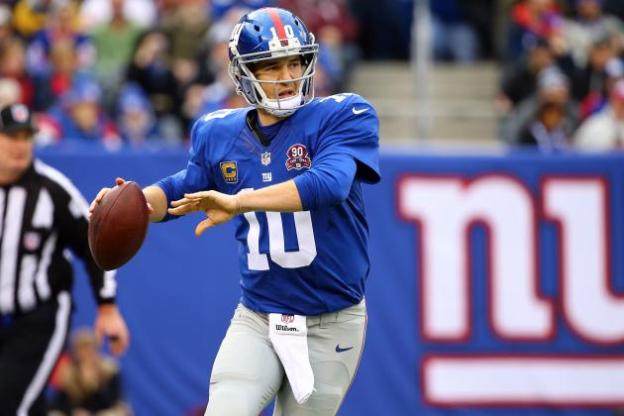
The main reason the Giants should consider sitting players like Eli Manning and Odell Beckham Jr. is that it makes no sense to risk your star players over a meaningless regular season game. Football is an inherently dangerous sport, and the more one plays it, the more likely it is that one gets hurt.

Those who think that teams should play their stars, even in meaningless games, like to point out that Week 17 is no more dangerous to players than any other game, as shown in the graph below.

In this graph, (found here, at Football Outsiders) the orange line shows that the risk of sustaining a new injury is stable throughout the season (Week 1 looks like a significant outlier, but, as the article notes, “anybody who suffers an injury in the offseason, training camp, or preseason will first appear” in Week 1’s stats). Accordingly, the logic goes, teams should play their stars because the risk of sustaining a new injury in Week 17 is no greater than the risk in any other game.

There’s an easy retort to this argument. While it’s true that a player is not more likely to get injured in Week 17 than in any other week, it’s also true that a player is more likely to get injured playing in a Week 17 game than sitting it out. Why should the Giants increase the risk of an injury to Manning or Beckham Jr. even slightly by playing them in a meaningless game?

It’s important to note that this graph does not indicate what kind of injuries were sustained. Obviously, there’s a significant difference in importance between a mild hamstring strain and a torn ACL, and that difference needs to be taken into account when determining the risks of playing one’s stars in a meaningless game. Logically, there’s no reason why the rate of serious injuries in Week 17 should be different than in any other game, but if anyone has any statistics on the matter, please email me at sushionsports@gmail.com.

Many will say that Eli Manning’s streak of 150 consecutive games started should not be broken, and that he needs to play to keep the streak alive. However, there’s a simple solution to this problem: play Manning for the first series of the game, and then sit him down for the rest of the afternoon.

The biggest reason the Giants should play their stars is out of loyalty to their fans. This game is being played in the Meadowlands, the Giants’ home stadium. The cheapest seat in the stadium, according to StubHub, is $50. That’s a significant amount of money to shell out for a team that’s not trying to win.

The Sixers, the preeminent tanking team, have realized that no one wants to pay a lot of money for a team that intends to lose. Accordingly, for their next home game, against the Timberwolves, the cheapest ticket available on StubHub is for a grand total of $9. That’s all. The price for a seat right behind the basket is $44. That’s cheaper than the cheapest seat in MetLife Stadium!

The Giants owe it to their fans, who are paying a lot of money to come watch the team play, to do their best to win the game. If it was on the road, that’d be another story, but it’s not. People come to Giants games to see Beckham Jr. and Manning, not Sidney York and Ryan Nassib.

And, just to prove my point, you definitely didn’t realize that Sidney York is the name of an electro-pop band, not a football player. Rather, it’s Elliott Brood who’s the current WR6 on the Giants.

So what do I think the Giants should do? It’s a tough decision, and I’m glad I don’t have to make it. Still, if I had to choose, I’d lean towards playing the stars for the sake of the fans. If I’m the Giants, I definitely don’t want to be compared to the Sixers.

And besides, who wants to see guys like Elliott Brood play football? Well, actually, it might be pretty awesome as, although you didn’t notice, Elliott Brood isn’t a wide receiver; it’s a Canadian alt-country band. And unless you want to see these guys playing for the Giants, you’d better hope the starters are playing on Sunday.

This article can also be found at Jock Journal.

Notes From Wizards-Clippers

I’m in DC right now, and a couple of nights ago, I took the opportunity to see the Wizards square off against the Clippers in the Verizon Center. Here a few observations from the game.

There were a couple of strange things that occurred during the game. For instance, at one point in the second half, plastic cows attached to mini parachutes were dropped from the rafters. Why? I think it had something to do with a Chick-Fil-A promotion, but honestly, I’m not sure.

The halftime show was immensely enjoyable. A pair of goals were set up at the free throw lines and a three on three game of soccer was held. The fun part was that, since each player was encased in a plastic bubble, it was impossible to get hurt, so the game was spent watching the players ram into one another. Always a pleasurable experience.

During the pregame warmups, I had a good time watching Josh Smith practice his free-throw shooting. Sorry Josh, even sinking sixty free throws in a row won’t make up for this travesty:

http://www.youtube.com/watch?v=ZCDDPH2mirQ

The game itself wasn’t overly exciting. Despite the absence of Blake Griffin, the Wizards were unable to take a single lead. The Clippers opened up the game on a 13-2 run and didn’t look back.

Cole Aldrich, of all people, had a solid game. He produced thirteen points, six rebounds, three assists, four steals, and a block over twenty minutes. Aldrich’s main contributions to the game were the four times he tried and failed to throw down a big dunk, leading to plenty of taunts from the stands.

DeAndre Jordan was particularly entertaining for a couple of reasons. One, whenever he has a big dunk, he hangs on the rim for a moment, letting his lengthy limbs loose:


Two, Jordan has a magnificent deer-in-the-headlights look whenever he goes to the free throw line. On his first two attempts, his anxiety, nervousness, and dread were plain to see:

As expected, he missed those free throws, although he rallied to make three of his next four to finish the night with a solid three of six at the line.

Throughout the night, the Wizards were discombobulated on offense. There were many possessions that ended late in the shot clock with a contested heave from John Wall. Even when a Wizard had a wide open three-pointer, more often than not, the shot clanked off the rim.

There was one notable near-achievement from a Wizards player: Jared Dudley, a starter, nearly earned a thirteen trillion. He played thirteen minutes, and recorded a grand total of zero points, rebounds, assists, steals, blocks, and fouls. The only thing keeping Dudley from a historic performance was one measly turnover. Alas. Better luck next time, Jared.

It’s indicative that I talked more about the sideshows, both literal and figurative, from the parachuting cows to DeAndre Jordan’s gangly legs, than about the game itself. I guess it was just that kind of night.

Still, despite the uncompetitive game, I had a good time, and it certainly was a…

This article can also be found at Jock Journal.

Should the Eagles have Fired Chip Kelly?

lEarlier tonight, news broke that Chip Kelly had been fired by the Eagles.

It’s an interesting decision, to say the least. Let’s take a look back at Kelly’s tenure in Philadelphia for some clues as to why this situation soured.

Way back in 2013, Kelly took over as head coach of the Eagles. Philadelphia was coming off a 4-12 season under the stewardship of Andy Reid and the team wanted a change and Kelly provided it.

In 2012, the Eagles’s pass/run ratio was 1.50. After Kelly’s arrival, it dropped all the way down to 1.01 in 2013. In addition to making LeSean McCoy owners in fantasy football incredibly happy, this approach helped the Eagles win the NFC East with a record of 10-6, although they lost to the Saints in the Wild Card Round, 26-24.

2014 was much of the same, with another successful offensive season producing another 10-6 season. However, Philadelphia missed the playoffs, so the season wasn’t considered to be a complete success.

After the season, Kelly took control of the player personnel department, allowing him to run the Eagles the way he saw fit. Over the course of the offseason, Kelly made a number of puzzling decisions, from signing Byron Maxwell to a big contract, to letting Jeremy Maclin go to Kansas City, to signing two running backs to contracts worth a combined $52 million. Despite all of these questionable moves, Eagles fans continued to repeat the mantra “In Chip We Trust”.

As it turns out, perhaps they shouldn’t have been so trusting. Philadelphia has been subpar, and a loss to Washington last Saturday night clinched a losing season.

Now that we have some context, we need to ask: Should the Eagles have fired Chip Kelly?

The answer, as it is so often, is unclear. Even with this poor 2015 season, Kelly’s record as Philadelphia’s head coach is still a solid 26-21. It’s surprising to see a coach with so much early success get fired as quickly as Kelly.

Kelly is clearly a very good coach; the problems started when he took over the player personnel department. If the Eagles just took away that power and kept him as the head coach, that would seemingly solve the problem.

Of course, it’s never that simple. Once you promote someone, you can’t ever demote them without ruining the relationship. Likewise, the Eagles can’t get rid of Kelly as the director of player personnel without also getting rid of him as head coach.

There’s now an opportunity for other teams to swoop in and hire Kelly because they can hire him just to coach without having to hand him control of personnel too.

Philadelphia was stuck in a bind, and they made the right choice. Having Kelly in charge of personnel was clearly not going to work, so even though he’s a great coach, he had to go.

This article can also be found at Jock Journal.

Trade Grade: Chapman to the Yankees

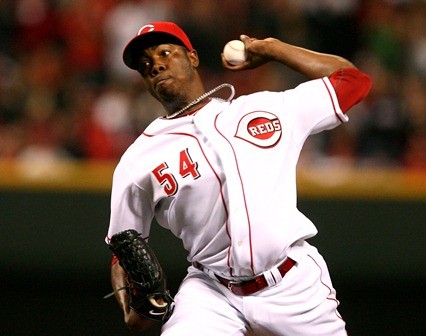
Earlier today, news broke that Aroldis Chapman was being traded to the Yankees in return for four prospects, Tony Renda, Caleb Cotham, Eric Jagielo, and Rookie Davis.

Cincinnati Reds

This trade is similar to the Todd Frazier trade in that the Reds again traded away a superstar for some decent prospects.

Renda is yet another second baseman, joining Jose Peraza, Brandon Dixon, and Brandon Phillips at the position. Cotham is a good reliever, with seventy-four strikeouts over sixty-six and two-thirds innings,  but he’s twenty-eight so he lacks upside. Jagielo, a third baseman, was a first round pick in 2013, and hit well this past season in the fifty-eight games he spent in Double-A. However, there are questions about whether he is capable of playing third base at the major league level. Finally, Davis is a starter who, at 22, had a good season split between Single and Double-A, striking out nearly a batter an inning.

According to MLB Pipeline, Jagielo and Davis are the sixth and tenth-best prospects in the Yankees’ farm system, so the return for Chapman is much better than what the Reds received for Frazier.

It’s surprising that the Reds got more for Chapman than for Frazier for a couple of reasons. One, Chapman is a free agent after this season, while Frazier will reach free agency after the 2017 season. Two, after a domestic violence incident in October, Chapman could be facing a lengthy suspension. That occurrence already caused the Dodgers to pull out of a trade for him, so being able to trade him while still receiving something of value is an impressive feat for Cincinnati.

Grade: B

New York Yankees

This trade makes New York’s bullpen utterly ridiculous. Between Andrew Miller, Dellin Betances, and now Chapman, the Yankees now have three of the best relievers in baseball. Teams are trying to copy Kansas City’s strategy of coping with poor starters by building a spectacular bullpen, but this relief corps is far better than the Royals’.

Now, as we noted earlier, Chapman could be facing a suspension for domestic violence. However, there is a potential silver lining. First, the suspension would take place at the beginning of the season, rather than at a pivotal moment in the pennant race. Second, if the suspension is lengthy enough, it could result in the Yankees receiving an extra year of control of Chapman, which would be spectacular for the team.

If New York can make the playoffs, it’s primed for a deep run thanks to their star-studded bullpen. Even factoring in the loss of a pair of good prospects and the public relations hit from Chapman’s domestic violence situation, this trade is a big win for the Yankees.

Grade: A-

Which Games Should You Watch on Christmas?

On Christmas Day, us fans of the NBA have a serious conundrum. There’s basketball for thirteen hours straight, which is great, but we also have familial obligations and the like. For those of you who can only escape your family for a game or two, here’s a guide to determining which games you should watch and which ones you shouldn’t.

Miami Heat vs. New Orleans Pelicans

Watch if you like: Freakishly long arms, all-lefty lineups, aging stars,  unibrows, imagining what Young Kristaps will be like in three years, having a quick snooze before the good games start.

Oklahoma City Thunder vs. Chicago Bulls

Watch if you like: Teams still finding their identities, power struggles, Enes Kanter’s bushy eyebrows, discontented players, Steven Adam’s fake-looking mustache, ex-college coaches in their first season in the NBA, Bobby Portis sitting on the bench, Dion Waiters hoisting up awful shots that miss by a mile.

Golden State Warriors vs. Cleveland Cavaliers

Watch if you like: Games with history behind them, unstoppable pick-and-rolls, superduperstars, injured players returning, going small, raucous home crowds, great basketball, ridiculous displays of shooting from Steph Curry, ridiculous displays of athleticism from LeBron James, Iman Shumpert’s hair, JR Smith hoisting up awful shots that somehow go in.

Houston Rockets vs. San Antonio Spurs

Watch if you like: Spectacular wing defense, Hack-a-Howard, intra-state rivalries, Spursgasms, foreign players, beards, dazzling sequences of passing, free throws, lefty shooting guards with Eurosteps.

Los Angeles Lakers vs. Los Angeles Clippers

Watch if you like: Kobe Bryant missing shots, thunderous dunks, Chris Paul to DeAndre Jordan alley-oops, young studs against in-their-prime superstars, brutal blowouts, watching the last quarter and a half played by scrubs.

Notes From Knicks-Cavs

Last night, the Knicks lost in Cleveland, 91-84. After watching the game, I have a few thoughts to share.

First off, at the end of the first quarter, there were .8 seconds remaining on the clock, enough time for a quick shot attempt. The ball is inbounded to Langston Galloway, but, instead of taking a shot immediately, he takes a couple of dribbles and takes the shot right after the buzzer sounds.

That type of behavior is something I’ve noticed a lot lately. Rather than taking generally futile last-second heaves, players have been messing around just enough that the shot is taken just after the end of the quarter. Instead of mumbling empty platitudes about doing everything possible to win and whatnot, why don’t players actually do that, instead of just pretending to try their hardest for the sake of a field goal percentage point or two?

In addition to Young Kristaps and YK, I may have another nickname for the Knicks’ Latvian star: KPP. I heard it from a friend; it stands for Kristaps Perfect Porzingis. I’ll try it out, and see if it feels comfortable.

Speaking of Latvia, the last time I wrote about KPP (I like it!), about 40% of the hits on the article came from Latvia, so for all my dear Latvian, KPP-loving readers, veiki, paldies par lasījumā, un iesim Knicks!

Young Kristaps had a pair of spectacular plays near the end of the first half. The first was a block of a layup attempt by LeBron James.

https://www.youtube.com/watch?v=2ntgY-MRC2Q

There were two impressive aspects to this play. First, the block came after YK read the play perfectly, noticing that Jose Calderon was guarding LeBron, who has fifty pounds and five inches on him, and walled off both the basket and the passing lane to his own man. To find the second thing, rewatch the video and pause it at eighteen seconds: KPP’s head is on one side of the rim and his arm is long enough that he’s able to reach across it to block the shot. That’s ridiculous.

The second play was a confident, swished, buzzer-beating three.

http://www.youtube.com/watch?v=qUsOtUqFtic

There was no hesitation whatsoever. Even from a few feet behind the three point line, his shot was smooth and unflustered. This play was in line with the rest of the game, as he hit four threes on five attempts.

There was one poor play at the start of the third quarter. On an Irving-Love pick-and-roll, Calderon and YPP both jumped out on Irving, leaving Love with an opportunity to nail a wide open three. I can’t say for certain if it’s the scheme’s fault or the players’, but either way, you can’t trap a ball handler, even if it’s Irving, if it means leaving a good three-point shooter like Love wide open.

The most mystifying part of this game came in the fourth quarter, when Young Kristaps didn’t play at all. Wait a second… He did? Sorry, I must not have realized since he didn’t take a single shot until a last second heave when the game was out of reach.

With Melo out, KPP is the Knicks’ best player—why is he not being given the ball? I understand that it’s never good to force up shots when they’re not there, but he was wide open from three point range multiple times and was ignored in favor of awkward, off-balance, mid-range attempts.

The team ended up scoring twelve points in the fourth quarter. Maybe, just maybe, ignoring Young Kristaps had something to do with it.

It’s especially annoying as the Knicks entered the final quarter tied, on the road, without their best player, against the best team in the Eastern Conference, but gave the game away. The points they left on the table could have given them the game.

Trade Grade: Frazier to the White Sox

Last week, news broke that Todd Frazier was being traded to the White Sox in a three-team trade. Frankie Montas, Trayce Thompson, and Micah Johnson headed from the White Sox  to the Dodgers, and the Reds received Jose Peraza, Brandon Dixon, and Scott Schebler from the Dodgers.

Los Angeles Dodgers

There’s little to say about the Dodgers, who acted as facilitators in this trade. They exchanged three prospects for three better ones, who are closer to the majors.

Johnson and Peraza are similar players, so that part of the trade is a wash. Both are second basemen, both don’t hit well, and both are speedy. The only important difference is that Johnson is two years older than Peraza, so he has a lower ceiling.

Every time I see Trayce Thompson’s name mentioned, immediately afterwards, the writer notes that he’s the brother of Klay Thompson. Out of respect to the former, we won’t mention the latter in this article (hey, wait a second…). Anyways, Thompson, a righty outfielder, was a pleasant surprise for the White Sox last season, hitting .295/.363/.533 across the 44 games he spent in the majors. He’ll be a useful bench player in Los Angeles.

Montas is another solid pick-up. Andrew Friedman, the Dodgers’ GM, said that the team plans on trying him out as a starter, but he views the twenty-two year-old as a potential  “impact bullpen arm”. Los Angeles’ bullpen was shaky last season behind Kenley Jansen so Montas could help shore up the relief corps.

Although the trade overall was a blockbuster, the Dodgers were not directly involved in the Frazier aspect of it. However, the deal helps Los Angeles improve without incurring a significant cost, making it a solid, if unspectacular trade.

Grade: B+

Cincinnati Reds

The Reds were expected to trade away Frazier. It’s a perfectly reasonable thing to do, as the team is currently rebuilding and Frazier will be a free agent after the 2017 season. However, one would expect the team to receive a tad more for their star third baseman.

Looking at their return, it’s easy to wonder what they were thinking. It was the right move to trade Frazier, but the combo of Peraza, Dixon, and Schebler isn’t particularly special.

The latter two players are largely insignificant. Dixon, a second baseman, turns 24 in January. He’s a non-prospect; despite hitting nineteen homers over the past season, one that he split between High-A and Double-A, his OBP was a dismal .303. The 25-year-old Schebler is better than Dixon, but only slightly. He made it to the majors earlier this season for nineteen games, and didn’t acquit himself too poorly, but he struggled in Triple-A and, due to his age, he’s not as likely to improve as a younger player.

Peraza, the apparent headliner of the deal was a top prospect only a year ago, but has since been traded twice, going from Atlanta to Los Angeles and now to Cincinnati. He’s a second baseman and offers a nice amount of speed. However, that speed is mainly appealing to fantasy owners, and a slash line of .293/.316/.378 over 118 games last season in Triple-A isn’t anything to write home about.

In case this wasn’t bad enough for the Reds, they’re not going to have second base available for Peraza and Dixon because their Brandon Phillips trade with the Nationals fell through after Phillips refused to waive his no-trade clause. Phillips is owed $27 million over the next two seasons, so either the Reds will have to eat his contract or find somewhere else for Peraza and Dixon to play.

Not only was the return for Frazier awful, but there’s not even an open spot to play the players received, making this trade an utter catastrophe.

Grade: F

Chicago White Sox

The White Sox are the big winners in this trade. The three players they gave up are all solid, as we discussed above, but Frazier is a genuine star. In 2014, he hit 29 home runs before following that up with another 35 this past season. That kind of power is increasingly rare and Chicago did well to snatch Frazier up once he became available.

Frazier will pair with Jose Abreu to form a fearsome duo of right-handed power hitters. That one-two punch should wreak havoc in the cozy confines of US Cellular Field. Chicago’s lineup is solid from top to bottom, with Adam Eaton, Brett Lawrie, Avisail Garcia, Melky Cabrera, and others flanking the pair of sluggers.

In addition to Frazier being very good, this trade is beneficial for the White Sox because they will no longer have to start Gordon Beckham at third base. Beckham, put simply, is not good, and Frazier is a massive upgrade over him. In an American League ridden with parity, one big addition can result in a massive improvement in playoff odds, and, as we all know, once you get into October, anything can happen.

Grade: A

Signing Grade: Heyward to the Cubs

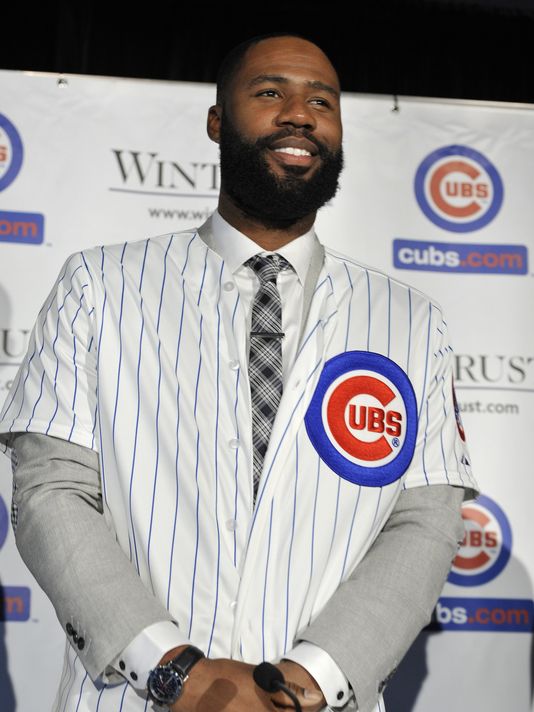
Last week, news broke that Jason Heyward was signed to an eight year, 184 million dollar contract by the Cubs. The contract includes a pair of opt-out clauses, after year three and year four. Those clauses are contingent on Heyward reaching a certain number of plate appearances.

The big winner here is obviously Heyward. 184 million dollars is a massive amount of money, and, thanks to the opt-out clauses, he’ll be able to re-enter free agency at age 29 or 30, where he’ll be able to land another big contract.

Heyward has to thank Atlanta for its help. The Braves brought him up to the majors at age 20, allowing him to reach free agency at 26, unlike most others, who reach free agency in their late twenties.

This is a great deal for Chicago as well. Due to his relative youth, a lengthy contract isn’t much of a burden. The deal keeps Heyward (barring any opt-outs) in Chicago until he’s 34, when, while he’ll have left his prime, he’ll still be a solid player.

The best thing about this contract from Chicago’s point of view is that Heyward, despite being a free agent, is roughly the same age as the rest of their young studs. Heyward is 26, a day younger than Anthony Rizzo, while the rest of the young core consists of the 23-year olds Kris Bryant, Jorge Soler, and Javier Baez, the 22-year old Kyle Schwarber, and the 21-year old Addison Russell. That lineup is loaded, and it’ll be loaded for the rest of the decade.

There’s only one potential problem. Heyward derives much of his value from his spectacular defense in right field. However, that’s where Soler plays, so Heyward, as of now, is expected to play in center field. He’s played there before, although not extensively; throughout his career he’s spent a total of 233 innings in center field.

The Cubs are fine with Heyward playing center field, but another option open to them is trading Soler, putting Heyward in right field, and then signing one of the free agent center fielders including Denard Span, Gerardo Parra, and Dexter Fowler, who played for the Cubs this past season.

Either way, when the only quibble with this contract is the mild problem of whether Heyward will be a good or great center fielder if he ends up playing there, it’s a pretty good deal.

Grade: A

Notes From Warriors-Bucks

Last Saturday night, the Warriors’ 24-game winning streak to open the season was ended, on the road, against the Bucks.

It was a spectacular game. I was cheering for history, and I never gave up hope until the Warriors were down eleven with ninety seconds to go. How could I? Golden State’s smothering defense can force turnovers and Steph Curry can rain threes, erasing even a double-digit lead in a minute or two.

The atmosphere at the game was electric. That phrase is overused, but in this case, it’s completely true. It’s only December, but the fans were cheering like it was a Game 7. The Bucks even handed out shirts reading “24-1” on the front.

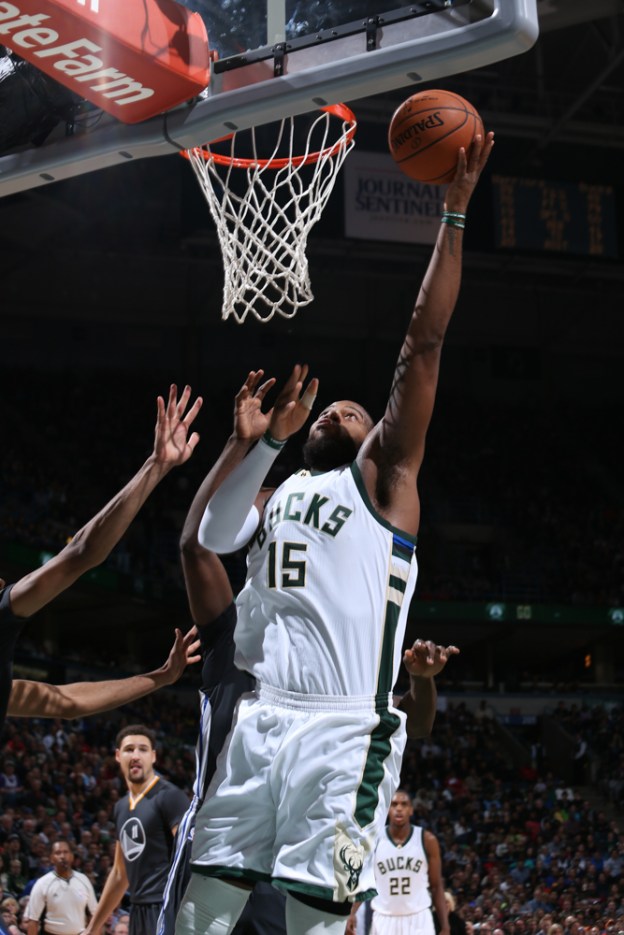
Greg Monroe was impossible to defend. The Warriors couldn’t go to the so-called Death Lineup (or as Curry calls it, the “Uh-Oh Lineup) thanks to Monroe’s punishing post-up game. He pushed through defenders all-game, throwing in lefty layups and floaters on his way to 28 points on a mere sixteen shots.

Giannis Antetokounmpo was unstoppable as well. Despite taking only 11% of his team’s shots, the Greek Freak was a force all game, compiling eleven points, twelve rebounds, and ten assists for a triple-double.

Even Michael Carter-Williams managed to put his shooting woes behind him, shooting seven out of ten from the field and scoring seventeen points. He played tenacious defense, racking up five steals, resulting in fast-break chances for easy points.

Most impressively for the Bucks was the poor shooting night they inflicted on Curry. The early favorite for MVP shot only ten of twenty-one from the field, including an awful two of eight from three-point range.

This inefficiency was not limited to Curry. The team as a whole only shot 40.9% from the field and 23.1% from three. The Warriors even managed to miss eight free throws.

Some people have decided that Milwaukee has managed to figure out the formula to beating Golden State. Let’s work through that formula together to see one, if it has any basis in fact, and two, if it will work in the playoffs.

First, this game was in Milwaukee. Assuming Golden State earns home-court advantage throughout the playoffs, an opponent will have to win in Oracle Arena to eliminate the Warriors.

Next, this game was a back-to-back for the Warriors, which contributed to their lackadaisical play early on. In the playoffs, there are no back-to-backs.

On top of that, Golden State’s game the night before was a double-overtime game in Boston. The Warriors’ best two players, Curry and Draymond Green, played an exhausting 47 and 50 minutes, respectively. After the draining game against the Celtics, the Warriors flew to Milwaukee, arriving at their hotel at around 3:00 AM.

Finally, Harrison Barnes, the starter at small forward and the fifth member of the Lineup of Death (alongside Curry, Green, Klay Thompson, and Andre Iguodala), sat out his eighth straight game due to a sprained left ankle.

To recap, the formula to beating the Warriors is to play them at home, after they played a double-overtime game the night before and got to their hotel at three in the morning, have one of their starters out with an injury, and force the best shooter in NBA history and his team into an uncharacteristic poor shooting night.

Sounds pretty easy to replicate. The Warriors are doomed.

Trade Grade: Castro for Warren and Ryan

Earlier this week, the Cubs traded Starlin Castro for Adam Warren and Brendan Ryan.

New York Yankees

Castro is a solid player. He can play both shortstop and second base, and flexibility at a pair of hard-to-fill positions is a valuable commodity in today’s MLB.

To get Castro, the Yankees gave up Warren and Ryan. Warren was expected to compete for a spot in the Yankees’ rotation this spring after pitching well last season, but now that he’s gone, New York will likely turn to CC Sabathia and Ivan Nova to compete for the fifth slot, behind Masahiro Tanaka, Luis Severino, Michael Pineda, and Nathan Eovaldi. Ryan was nothing more than an occasional starter at second base, the position that Castro will now occupy, so his absence won’t be missed.

Castro is an interesting asset. Although this will be his seventh season in the big leagues, he’s still only 26 and is signed through 2019, his age-29 season, with a club option for 2020. His contract isn’t onerous, as over the next four seasons, Castro is owed 37 million dollars, plus the club option, which will cost sixteen million dollars (or a one million dollar buyout).

On the other hand, since a spectacular first couple of seasons in the majors, Castro has regressed badly, with a .296 OBP last season. However, there may be reason for optimism. After moving from shortstop to second base last season, across 44 games, Castro played better defense while hitting .353/.374/.594. Obviously, Castro won’t put up those stats over a full campaign, but if he can approach his production from his first couple of seasons, then this trade will be a coup for the Yankees.

Grade: B

Chicago Cubs

I’m not sure why the Cubs made this trade. Yes, Castro was expendable because Addison Russell and Javier Baez will be occupying the middle-infield positions for the foreseeable future, but couldn’t Chicago have gotten something a little more useful for a young, relatively cheap player?

Ryan has a reputation for being a spectacular defensive shortstop, with his four year peak producing 12.4 WAR (as per Baseball-Reference). However, that peak was from 2009 to 2012, at which point his defensive production fell off a cliff, going from 3.6 dWAR (defensive WAR) in 2012 to .7 dWAR in 2013. Last season, he reached his nadir, producing negative value as a defender. He can’t hit for his life, which was acceptable when he was a world-class defender, but now that he can’t play defense any more, simply put, he’s an awful player.

The Cubs don’t need him whatsoever, with shortstop reserved for Russell for years to come, so I imagine he was just a throw-in and that Warren was their main target.

Warren pitched well last season, with a 3.29 ERA across 131.1 innings, including seventeen starts. This isn’t a fluke as his combined ERA across his three full seasons is 3.23. The problem is that there’s no space in the rotation for him, with Jake Arrieta, Jon Lester, John Lackey, Jason Hammel, and Kyle Hendricks occupying every spot in the strangely J-heavy Chicago rotation.

Warren has also pitched in the bullpen, so he’ll likely begin next season as a reliever. He’ll be perfectly fine in relief, but is a solid reliever really worth Castro? Apparently, the Cubs think so, but I’m dubious.

Grade: C+