Earlier today, news broke that Houston had traded Donatas Motiejunas and Marcus Thornton to Detroit for Joel Anthony and a top-8 protected 2016 first round pick. Houston then sent Anthony along with Denver’s 2017 second round pick to Philadelphia for the rights to Chukwudiebere Maduabum.
Detroit Pistons
The Pistons should have just stopped while they were ahead. After ripping Orlando off in Tuesday’s trade for Tobias Harris, Detroit had long-term starters at all five positions and adding in Motiejunas only creates a logjam in the frontcourt.
Furthermore, Motiejunas is coming off a serious back injury and is a restricted free agent after this season. At that point, after only two months of playing for them, the Pistons will have to decide whether or not to shell out a significant amount of cash to keep Motiejunas around for years to come.
It’s not like Motiejunas is a bad player. The seven-footer is capable of shooting threes, having shot nearly 37% from downtown last season on 1.9 attempts per game. He’s a useful player to have around as he provides flexibility as a stretch big man.
The problem isn’t Motiejunas; it’s the price the Pistons had to pay for him (and also Thornton, who was a throw-in, even though he had some nice moments early in the season).
That first rounder would have been another cheap player to add to their core, but instead, they’ll likely be forced to pay a ton of money to keep Motiejunas in restricted free agency after the season.
It wasn’t an awful idea for Detroit to acquire someone like Motiejunas, but there were certainly cheaper ways to do so.
Grade: C-
Philadelphia 76ers
Sam Hinkie has done it again. Hinkie managed to insert himself into yet another trade, allowing him to acquire his one-hundredth second round pick, an important milestone for him.
Maduabum isn’t an NBA prospect, so the trade is really just Philadelphia taking on Anthony’s salary in return for that second round pick. Even better, the Sixers save about $1.5 million because they’re now over the salary floor thanks to Anthony.
The best thing of all is that Anthony’s $2.5 million salary in 2016-17 is fully unguaranteed, giving Hinkie flexibility that will allow him to make advantageous trades in the offseason.
This deal isn’t important enough to warrant effusive praise for Philadelphia, but it did a good job in using its excess cap space to scoop up extra assets.
Grade: A
Houston Rockets
This trade was a coup from Daryl Morey. He managed to turn a couple of unused players he was unwilling to pay into a first round pick. Sure, it’s not going to be a high pick, but even a pick in the teens is plenty valuable, especially since the draftee will be on a dirt cheap rookie contract.
The Rockets also managed to escape paying the luxury tax by giving the Sixers a second rounder, saving them millions of dollars.
Foisting a couple of unwanted players onto Detroit and receiving a first round pick and millions of dollars in savings in return is a job well done by Houston.
As fans, blockbusters are fun to think about. It’s great to imagine stars flying around willy-nilly, the landscape of the league changing every other minute.
The problem with blockbusters is that they almost never occur. The reason why blockbusters so rarely happen can be easily explained by Newton’s first law: An object at rest will stay at rest unless acted upon by an outside force (thanks 8th grade science!). GMs are unwilling to gamble their jobs on one big move, so rather than taking a chance, they’re content to just sit back and do nothing.
There are a couple of stars rumored to be available: Blake Griffin and Dwight Howard. However, it’s unlikely that a team overcomes its inertia to pull off a blockbuster trade for either of them, because Doc Rivers’ asking price for Griffin is sky-high and teams have little interest in trading for Howard, who’s on an expiring contract, is declining, has dealt with nagging injuries, and will expect a max contract in free agency, one that starts at $30 million per season. In addition, the team that has the most assets available in a trade and is looking for a star, the Celtics, “have recoiled at paying a price Houston would find acceptable,” according to Zach Lowe of ESPN.
Speaking of those Celtics, although they won’t be going after Howard, there are still plenty of other options. And that’s the impetus for the blockbuster trade that absolutely needs to happen:
New York trades Carmelo Anthony to Cleveland
Cleveland trades Kevin Love to Boston
Boston trades David Lee, Kelly Olynyk, Terry Rozier, James Young, unprotected Brooklyn 2016 1st round pick, top-7 protected Dallas 2016 first round pick to New York
I absolutely love this trade. It works for every single team involved.
As we were just saying, the Celtics are in the hunt for a star, and Danny Ainge has long been an admirer of Love’s game. The two make a perfect fit.
Personally, I’m not so high on Love, as to me, he’s just a more famous version of Olynyk, but if Ainge wants him, this is a reasonable price to pay. Even better, unlike Howard, Love is signed long-term; he won’t reach free agency until 2020.
Losing five good young players will hurt, but as we discussed a few days ago, the Celtics might have too many good players (if that’s possible) and are therefore unable to play them all. The same logic in trading three good players for a very good player like Al Horford applies here as well.
This trade would make Anthony happy. Melo said last Friday: “I think everybody always kind of dreams and hopes that they can play with another great player, another star player,” adding “It’s a star players’ league. I think that’s what we all talk about every time we get together.”
We can infer from that quote that Anthony is hoping to play with a star and doesn’t want to wait for Kristaps Porzingis to blossom into one. And what better a way to do it than to join his friend LeBron in Cleveland for a title run?
Every couple of years, we see Melo on Team USA, enjoying himself, just swishing three-pointers whenever someone passes to him. On the Knicks, he can’t be a complimentary player; on the Cavaliers, he can. Even better, if Tyronn Lue decided to stagger his three stars’ minutes, two of LeBron James, Melo, and Kyrie Irving would be out on the floor at the same time. All three of those guys can create shots for themselves and others, meaning that Cleveland’s offense wouldn’t miss a beat when LeBron takes a breather.
Speaking of LeBron, this trade would make him happy too. James has historically wanted to play with his friends, and Melo would make basketball sense for the Cavs as well.
Love is shooting 36.8% from three-point range, while Anthony is shooting 32.7%. However, Anthony is attempting far more challenging shots than Love; 61% of his three point attempts have come on catch-and-shoots, compared to 91% of Love’s. As you can see, unlike Love, Anthony is capable of creating his own shot. And, as more of a complimentary player, Anthony will be playing off the ball more, leading to more catch-and-shoot attempts. That’ll raise his 3FG% much closer to Love’s.
Defensively, Anthony is far superior to Love. A good way to measure defensive prowess is by defensive field goal percentage. Comparing the player’s defensive FG% to the usual FG% of the player being defended allows us to find out how the defender is playing when compared to an average defender. To illustrate this point, holding Stephen Curry to 45% shooting is considered a success, while allowing Lance Stephenson to shoot 45%, well, isn’t.
Anyways, in this regard, Anthony is a big winner. He ranks sixth in the NBA among the players who have played in at least forty games, holding his opponents to a FG% 6.3 percentage points lower than their norm, while Love ranks 229th out of the 250 players, with a mark of +4.3.
As we can see, Anthony is a clear upgrade over Love. Naturally, that leads to the question: Why wouldn’t the Celtics just trade for Melo instead? Well, Anthony has a no-trade clause, and although he’ll likely waive it if he’s sent to Cleveland to play with LeBron, he’s unlikely to allow the Knicks to trade him to Boston. On top of that, Love is 27, four years younger than the 31-year old Melo, which makes him a better fit for the up-and-coming Celtics team.
Now that we’ve established why both the Cavaliers and the Celtics would make this trade, it’s time to figure out why the Knicks would too.
Well, it’s really not that hard to figure out. Anthony is nearly twelve years older than Porzingis, and by the time the latter enters his prime, the former will be way past his. Accordingly, the Knicks would be wise to build around Porzingis and this trade would allow them to do so.
Porzingis is 20, Rozier is 21, Olynyk is 24, and Young is 20. The two 2016 first rounders will be similarly aged. Add in the 23-year old Jerian Grant and the 24-year old Langston Galloway, and that’s the start of a damn good roster.
The Knicks will also have control of all of those players for years to come, allowing them to develop chemistry through continuity.
The last guy New York would acquire is Lee. He’s an unimportant part of this deal, as he’s on an expiring contract and would be included just to make the salaries work.
Again, I’m doubtful that this blockbuster will ever occur, but if ever there were a time for NBA teams to overcome their inertia to actually make a trade, this is definitely the trade with which to do it.
Earlier today, news broke that Orlando had traded Tobias Harris to Detroit in exchange for Brandon Jennings and Ersan Ilyasova.
Detroit Pistons
This trade immediately turns the Pistons into long-term Eastern Conference contenders. No, they’re nowhere near even an NBA Finals run, but this trade gives them a great shot at a playoff series victory or two if they can vault up past the eighth seed to avoid Cleveland in the first round.
It’s not like what happens this season matters that much. If Detroit wins a playoff series, great! If it wins two, even better! The best thing about this trade is that it’s not some insane win-now move for a team that won’t win anything; it’ll help the Pistons a ton in the future.
Ilyasova and Jennings, 28 and 26 respectively, are veterans. Ilyasova is signed for the rest of this year and has an unguaranteed salary in 2016-17 while Jennings is on an expiring contract. Neither of those two guys will be around for very long.
Harris, on the other hand, is in the first season of a four year, sixty-four million dollar contract. It seems like a lot of money, and it is, but thanks to the rapidly rising salary cap, sixteen million dollars a year isn’t much to spend on a player like Harris.
Best of all, Harris is 23 years old. The other players worth keeping the Pistons have are all at similar ages: Kentavious Caldwell-Pope is 22, Stanley Johnson is 19, Andre Drummond is 22, and at 25, Reggie Jackson is the elder statesman of the bunch. Together, these five players form a rapidly improving core and will be in their primes at roughly the same time.
Harris is a tweener, and toggles between each forward position. When he plays power forward, the other four members of the core are able to play as well; when he plays small forward, Marcus Morris can play at the four. Either way, there should be plenty of minutes freed up for him, especially with Ilyasova’s 27.6 minutes at power forward now gone.
Detroit has acquired a 23-year old player who’s already a solid starter and is locked into a cap-friendly deal for the next three seasons. All it had to give up to get him were a couple of veterans who didn’t fit the team’s timeline for contention. Overall, this was a coup for the Pistons.
Grade: A
Orlando Magic
It’s tough to see what Rob Hennigan was thinking here.
As we discussed above, Ilyasova and Jennings are veterans without upside and with no guaranteed money beyond this season. Harris, on the other hand, is a twenty-three year old oozing with upside, and is signed for three more seasons.
Remember what we said earlier about Harris fitting in with Detroit’s core age-wise? Yeah, he fits even better with Orlando’s: Victor Oladipo is 23, Elfrid Payton turns 22 next week, Mario Hezonja is 20, Evan Fournier is 23, Nikola Vucevic is 25, and Aaron Gordon is 20.
Harris could have grown and matured alongside a core that is under Orlando’s control for at least another season and a half. In the NBA, continuity is priceless, as we’ve seen with elite teams like the Warriors and Spurs. In the present day climate, with increasingly short contracts, continuity is elusive, and the Magic, for some strange reason, decided to give up a big part of theirs.
And what did they give him up for? Almost nothing! At best, Jennings and Ilyasova are “veteran mentors” who can “show the youngsters how to win”. The only problem with that explanation is that Jennings and Ilyasova have been on winning teams only once apiece, on the 2009-10 Bucks team that won a grand total of forty-six games.
Speaking of that team, interestingly enough, it was coached by none other than Scott Skiles, who also happens to currently coach the Magic.
Anyways, if Ilyasova and Jennings aren’t particularly good, and if they don’t have much experience winning, and if they won’t be around long-term, then why in the world would Orlando trade for them?
This deal seems a lot like a win-now move, except that Orlando is worsening its future whileworsening its current team too. One other problem with this win-now move? The Magic currently sit in eleventh place in the Eastern Conference, with a record of 23-29. To make the playoffs, they’d have to vault over three teams, including the Pistons, just to get the eighth seed, where they’ll promptly be slaughtered by Cleveland in the first round.
The single possible benefit for the Magic in this trade is acquiring Ilyasova’s unguaranteed contract for 2016-17. In the offseason, they’ll be able to trade Ilyasova to a cap-starved team and pick up an asset for their help as a cap-declogger. However, the asset that they receive in return for Ilyasova is unlikely to be anywhere near as valuable as Harris is.
Again, there’s little upside to this deal, and a ton of downside. The Magic aren’t winning now, but this trade hurts their chances at winning in the future.
Unless there’s something about Harris that the public doesn’t know, this trade was a grave mistake for the Magic.
Lately, rumors have been rampant that the Hawks intend to blow up their team. I don’t really understand why they would, as they’re currently in fourth place in the Eastern Conference and eighth in the NBA in point differential at +2.7.
Yeah, three of their five starters are hitting free agency this offseason, and yeah, they don’t have a chance at winning the championship, but as of right now, they’re locks to win between six and ten playoff games.
Perhaps the Hawks are done settling for mediocrity and have decided that they either want a really good team or a really bad team. It makes sense, but it’s too bad that the NBA’s rules make being a run-of-the-mill good team something undesirable.
Anyways, what’s more interesting is that the Celtics have been rumored to be interested in trading for Al Horford. Does it make sense for them to do so?
Horford isn’t a superstar, but he’s definitely an elite player, and besides, unlike many players, his skill set allows him to fit into almost any team. Horford is something of a stretch-center, in that he’s capable of defending centers while being able to shoot threes on offense.
Naturally, that malleability is appealing to the Celtics, but what would they have to give up to get him?
Despite reports of Atlanta’s asking price for Horford being “borderline ridiculous,” as the trade deadline nears, it will likely drop to more reasonable levels. For Boston, that’ll mean an offer along the lines of the Dallas top-7 protected first rounder and a couple of rotation players.
Giving up two rotation players, such as Jonas Jerebko and Jared Sullinger, along with the Dallas pick will hurt, but a three-for-one will benefit the Celtics in another way. With all their picks and their current roster, the Celtics will soon have so many good players that they won’t be able to play them all. In fact, that’s a problem they face now, as solid players such as Jerebko and David Lee play less than sixteen minutes a game.
Trading for Horford means trading away three solid players for one very good one. For many teams, that wouldn’t be a good idea, but for the Celtics, it’s another bonus to the deal.
Some may say that it makes no sense for Boston to trade for Horford because it’s foolish to go all-in when they don’t have a chance at the championship. However, would it really be all-in?
If the deal we discussed earlier comes to fruition, the Celtics won’t come close to being “all-in”. They’ll keep their best long-term asset in the unprotected Nets first rounder, and their core of Marcus Smart, Isaiah Thomas, Avery Bradley, and Jae Crowder will remain untouched.
The main roadblock to a Horford-to-Boston trade is Horford’s impending free agency. Still, that’s not a deal-breaker. The Celtics may trade for Horford anyways if they’re confident in that their team and culture will appeal to him and entice him to resign. Alternatively, similarly to the Goran Dragic trade last season, the Celtics can extract an unspoken promise from Horford that he’ll return in free agency.
Overall, it would make sense for Boston to trade for Horford, assuming that they don’t have to give up the Nets pick or part of their core, and if they know they’ll be able to keep him long-term. Otherwise, it’s too high a price to pay for three months of a very good center and a better shot at a run to the Eastern Conference Finals.
Just before January 30th’s Cavs-Spurs game, Heather Cox, an ESPN sideline reporter, had an exciting announcement: ESPN would now be using a “new technology”, a virtual three-point line.
Cox later mentioned that the supposedly “new technology” was based off of the 1st and 10 technology in football, a blatant contradiction.
Anyways, Cox explained that the virtual-three point line would light up after every three-point attempt and remain lit up until the next possession if the shot was made.
To further explain this innovative technology, here’s a GIF so you can see it in action:
This “cool technology” (as Cox put it) is such low-hanging fruit that I almost feel guilty for making fun of it. Almost.
I’ve gotta wonder whose brainchild this one was. Perhaps some random executive’s seven-year old kid pressed a few random buttons during “take-your-child-to-work day”; after all, what other explanation could there be?
Perhaps I’m judging a little hastily. Maybe I’m wrong about this technology. Let’s talk about why it’s useful.
One of the best things about it is that it caters directly to one specific subset of the population: the people who can’t see a player taking a jump shot but who can see a red line lighting up right next to the shooter. That demographic is obviously a huge part of the sports-watching population and ESPN did well to creatively cater to its needs.
Another demographic that this technology helps is the one consisting of people who can’t see the basketball going through the net or hear the announcers telling the audience what just occurred but who somehow are able to see the three-point line up. Yet another wise business decision by ESPN.
For those of us who don’t belong to either of those groups, this technology is still useful. After a three-pointer, the line lights up for a few seconds. In the meantime, many teams try to get fast-break points against opponents who have fallen asleep. They’ll quickly inbound the ball and push up the floor as fast as possible. For much of the time the three-point line is lit up, the viewer can’t see it as action occurs on the other side of the court. I, for one, still think that the technology is useful because, somehow, I find it reassuring to know that the three-point line is lit up, even though I can’t see it.
I know that this technology is based off of the 1st-and-10 technology, but I wonder how ESPN implements it during the game. My best guess: Some poor intern at a computer has to press control-b every time a three-pointer is attempted.
Cox added at the end of her explanation: “I certainly hope you enjoy this new toy as much as we do.” Yeah, Heather, I’m definitely enjoying this “new toy”, but probably not for the reasons you intended.
Just over a week ago, on NBA Countdown, Jalen Rose was discussing the upcoming game between the Warriors and Bulls. While doing so, he asserted that Klay Thompson is the best catch-and-shooter in the NBA. Is he right?
Before we can answer that question, first we need to determine exactly what a catch-and-shooter is.
The NBA defines a catch-and-shoot attempt as “any jump shot outside of ten feet where a player possessed the ball for two seconds or less and took no dribbles”. That’s a reasonable definition. To ensure that only real catch-and-shooters showed up in the rankings, I tweaked the requirements; this list is limited to players who play at least twenty-four minutes a game while attempting at least three threes per game. This leaves us with fifty-eight players in the NBA who qualify as true catch-and-shooters.
How does Thompson rank under those parameters?
The answer? Very well, but not the best.
He’s eleventh in effective field goal percentage (eFG%) with 61.4%. He’s behind superstars such as Stephen Curry, Damian Lillard, and Kawhi Leonard, well-known three-point specialists including J.J. Redick, Khris Middleton, and J.R. Smith, and guys who you wouldn’t expect to be there like Jerryd Bayless and Patrick Beverley.
Thompson is tenth in catch-and-shoot three point percentage, again behind Curry, Leonard, and others. Again, he’s in the top fifth of the league, but he’s not quite the best.
However, Thompson is able to maintain his efficiency over far more three-point attempts than others. He leads the league with 6.3 catch-and-shoot attempts per game, 0.9 more than his closest competitor, Wesley Matthews. Matthews is closer to ninth place Curry than he is to first, showing how efficient Thompson is.
Similarly, Thompson leads the league in catch-and-shoot three-pointers made per game, with 2.8. This time, second place Curry is closer to eleventh place than he is to first.
Although we can’t say that Thompson is the most efficient catch-and-shooter in the NBA, his ability to maintain a relatively high level of efficiency over so many attempts speaks to his immense proficiency at catch-and-shooting.
In the end, while it’s not cut-and-dried, it’s a reasonable assertion to make that Klay Thompson is the best catch-and-shooter in the NBA.
I don’t think anyone was expecting the utter devastation the Warriors wrought upon the Spurs. I don’t think anyone was expecting Stephen Curry to explode for thirty-seven points in only twenty-eight minutes. I don’t think anyone was expecting San Antonio’s point differential to go down a full point. I don’t think anyone was expecting any of this.
The important question is: How did this happen?
The answer, simply, is that rather than running their usual motion offense, the Spurs decided to try their hands at running a bakery. The problem is that the only pastries they knew how to cook were turnovers (mostly apple ones). All (bad) jokes aside, the Spurs continually hemorrhaged possessions last night, giving the ball to the Warriors in a variety of ways.
Naturally, the multitudinous turnovers were a problem for San Antonio, but the fact that it’s bad to turn the ball over isn’t enough to explain the blowout. After all, it’s not like Golden State took particularly good care of the ball; it had twenty-one turnovers to San Antonio’s twenty-six (which is eighth-most out of 1348 team games played so far this season!).
In fact, just turning the ball over alone doesn’t matter all that much. Take a look at a graph:
In this scatter plot, the x-axis is turnovers per game while the y-axis is winning percentage. As you can tell from the relatively even scatter of the graph, there’s only a very weak negative correlation (the r is -.36) between turnovers and winning percentage.
If turnovers don’t inherently affect winning, then why did they hurt the Spurs so significantly against the Warriors?
When a team turns the ball over, that often leads directly to a fast break, a facet of the game in which the Warriors excel. In fact, Golden State leads the league in fast break points with 20.7 per game, an impressive 2.76 standard deviations above the mean. To illustrate that number, take a look at a scatter plot of NBA teams and how many fast break points they have per game:
Look how far the Warriors (the star in the upper right corner) are away from everyone else. In fact, they gap between them and sixth place is larger than the gap between sixth place and thirtieth!
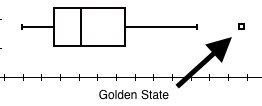
Golden State is so aberrant in this regard, that, as shown by the following box plot, it qualifies as an outlier:
As we can tell, Golden State’s offense relies a lot on fast breaks, and we’ve already covered how turnovers often lead to fast breaks. Now let’s take a look at San Antonio’s defense.
The Spurs allow 11.2 fast break points per game, ranking sixth in that category. As seems to be customary between these teams, two strengths are in direct conflict.
In this case, the Warriors’ strength won out. They scored nineteen fast break points, about two points under their average, but roughly eight points more than the Spurs’ average.
Now, one important aspect of a fast-break is the “fast” part. The Warriors rank first in the NBA in pace, while the Spurs are the eighth slowest team in the league. Since Golden State was able to take control of the pace of the game, San Antonio was out of its element. It didn’t help matters that the Spurs’ average age is 30.5, the oldest in the league by over a year. In fact, that’s likely a significant part of why they play so slowly.
Anyways, to sum it up, the main reason the Warriors were able to dismantle the Spurs on Monday night was because they were able to take control of the pace of the game through forcing turnovers. Those turnovers allowed them to score plenty of fast break points, erasing one of San Antonio’s biggest strengths.
Here’s a bonus question: Did this game provide a blueprint for how to beat the Spurs?
I’ll put it simply: Do many teams have a guy who can do things in transition like this?
Yeah, I didn’t think so.
And aside from the otherworldly talents of Curry, the Warriors, as we’ve discussed, have a lot more going for them that other teams simply don’t have.
But even the Warriors haven’t figured out the formula to beating the Spurs. San Antonio had nearly double its usual turnovers and Tim Duncan was sitting out. There were plenty of other factors that contributed to the blowout that are unlikely to recur all at once.
Although this clearly is not a death knell for the Spurs, it could be a chink in their formerly unbroken armor, and perhaps particularly skilled teams will now be able to exploit it.
Tonight, the Spurs and Warriors will meet for the first time this season, in Oracle Arena. Not only are these teams the two best in the NBA this season, they’re also two of the best in NBA history. In fact, here’s a list of every single team that has ever posted a point differential above plus-12 like the Spurs and Warriors have so far this season:
So yeah, that’s ridiculous. Even better, the three other teams on that list all went on to win the championship. The problem is that the Spurs and Warriors can’t both win the championship. In fact, as both teams play in the Western Conference, only one team can even make it to the Finals. Accordingly, the Western Conference Finals (assuming both the Spurs and Warriors make it) will be the de facto NBA Finals, as the winner of that series will go on to the real NBA Finals to demolish whichever flawed team emerges from the East.
Tonight’s game is truly a clash of titans, one that is quite possibly the greatest regular season matchup in the history of the NBA.
In honor of tonight’s game, it’s time to figure out which team is better and should be considered the favorite to take home the Larry O’Brien Trophy in June.
Offense
The Warriors lead the NBA significantly in points per game. They score 114.7 points per game, 6.2 more than the second place Thunder. The gap between the Warriors and the Thunder is the same as the gap between the Thunder and the ninth place Pelicans. To illustrate this point, here’s a graph of the points per game totals among NBA teams:
That star in the upper right hand corner is the Warriors. Look at how far they are away from everyone else. In fact, they’re 3.27 standard deviations above the mean, meaning that, assuming a normal distribution, one would expect an offense to score as many points per game as them .05% of the time. That’s about once every sixty-seven seasons. Wow.
However, that point total is skewed somewhat by Golden State’s pace. They play at the second fastest pace in the league, averaging 101.75 possessions per game, behind only Sacramento. Meanwhile, the Spurs play far slower, at the sixth slowest pace in the league, averaging 95.91 possessions per game. That’s a difference of nearly six possessions per game, allowing the Warriors to average more points than the Spurs.
If, instead of points per game, we use points per hundred possessions, the gap between the Warriors and the rest of the league shrinks significantly:
Here, the Warriors still lead the pack at 112.7 points per hundred possessions, but the Thunder (second at 109.2) and the Spurs (third at 108.8) follow close behind them.
Although Golden State’s offense is clearly the best in the game, the San Antonio’s isn’t all that far behind.
Edge: Warriors
Defense
The Spurs, similarly to the Warriors on offense, lead the NBA in points allowed per game by a significant margin, allowing a stingy 89.8 points per game. In fact, San Antonio’s defense (the star in the lower left corner) is nearly as far away from the rest of the league as Golden State’s offense:
Golden State, on the other hand, ranks a mere eighteenth in points allowed per game, giving up 102.6 points per contest.
However, in addition to offensive numbers being skewed by pace, defensive numbers are skewed too. After all, it’s a lot easier to give up fewer points when you don’t have to face as many shot attempts.
To combat this, like we did with offense, let’s use points per hundred possessions:
This change actually doesn’t affect the Spurs at all; in fact, it might even increase the gap between them and the rest of the league. However, the Warriors vault from eighteenth all the way up to third, a sizable jump.
Similarly to offense, while San Antonio’s defense is clearly the best in the NBA, Golden State’s isn’t too far behind.
Edge: Spurs
Chemistry
Golden State leads the NBA in assist percentage, as 68.5% of its field goals are assisted. San Antonio isn’t far behind, sitting in sixth place with an assist percentage of 61.7%. In addition, the Warriors are the proud owners of six of the eleven games this season in which a team accumulated thirty-five or more assists.
There are plenty of stats that I can use to show how great the Warriors’ chemistry is, but they can’t compete with the Spurs. No one can. A couple of years ago, San Antonio had this video made about them:
Sure, plenty of other teams pass, but have any of them had videos like this one made about them? I actually looked; there are none.
If you want something more recent, here are the Spurs earlier this season, destroying the Timberwolves:
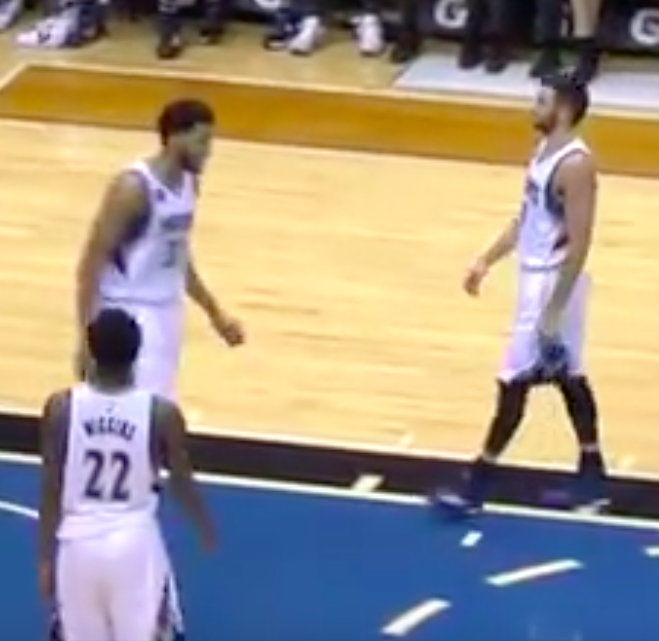
I mean, just look at how disconsolate the Timberwolves are after the Spurs finally decided to score:
That’s what the Spurs’ passing can do to a team.
Last of all, and best of all, who can forget the famous Spursgasm from a couple of years ago?
Good lord.
Big Edge: Spurs
Coaching
This might be the tightest category yet. Steve Kerr took over a Warriors team and, with largely the same roster, turned a 51-31 sixth seed into a 67-15 juggernaut. This season, with Kerr sidelined, Luke Walton has led the Warriors to a 39-4 start.
The Spurs have Gregg Popovich, the best coach in the league hands-down, and one of the best coaches of all-time.
No matter how good Kerr and Walton have been while helming Golden State, no one can equal Pop, but at least they’ve been able to come close.
Slight Edge: Spurs
Star Power
You’d think that this category would be an easy Warriors victory, but it’s a lot closer than you’d think. Each team has a superduperstar, Stephen Curry for the Warriors and Kawhi Leonard for the Spurs. Each team has a superstar, Draymond Green for the Warriors and LaMarcus Aldridge for the Spurs. The intrigue comes in the various supporting players.
San Antonio has so many good, solid players, from Tony Parker to Manu Ginobili to Tim Duncan to Boris Diaw to Danny Green. Even players buried a little deeper on the bench are still capable, like David West and Patty Mills.
On the other hand, Golden State has a far top-heavier rotation. Andrew Bogut is a solid center, Shaun Livingston is a good back-up point guard, and Harrison Barnes and Andre Iguodala are very good small forwards. Deeper on the bench are players such as Festus Ezeli, Leandro Barbosa, and Marreese Speights, three players who are all decent, if unspectacular.
In the end, the Spurs’ superior depth doesn’t matter as the Warriors have a third star in Klay Thompson, giving Golden State the advantage in the final category.
Edge: Warriors
Verdict
No matter which team is better, the Warriors should be expected to win tonight due to their immense home court advantage, but, in the end, by the tiniest of margins, the Spurs are the superior team.
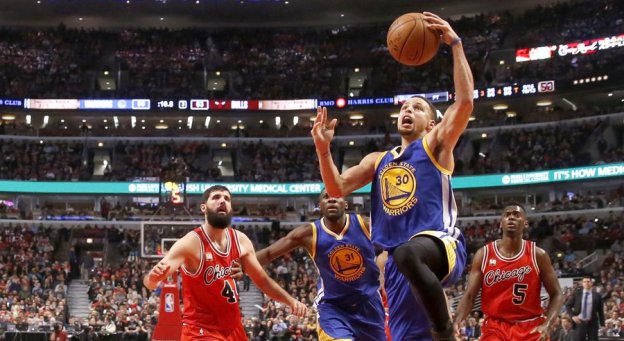
Last night, in addition to the Knicks-Jazz game, I watched the Warriors and Bulls square off in Chicago. Here are a few observations from the game.
Derrick Rose looked spectacular. His performance hearkened back to his MVP season in 2011, not only in what he did, but in how he did it. His first four baskets came on a twisting layup, a wild bank shot, a floater, and another banker.
Rose finished with twenty-nine points, many coming on those same sorts of ridiculous shots that barely anyone else in the NBA would even bother attempting.
The Warriors have become a spectacle. Throngs of fans show up early to games when the Warriors come to town, hoping to see magic happen. Stephen Curry is at the center of it all, but even so, it was surprising when the Bulls fans filling the United Center let out a mildly disappointed “Oh” when he missed his first three-point attempt.
The Bulls did one particularly strange thing early in the game. Many teams like to trap Curry on pick-and-rolls, knowing that to let him free is an invitation for a swished three-pointer. That trapping leads to four-on-threes for Golden State, but those are preferable to giving up an open shot to Curry.
While it makes sense to trap Curry, the Bulls strangely decided to trap Klay Thompson off a pick-and-roll, leading to a four-on-three led by Curry. Why in the world would they choose to do that? One has to assume that it was a gaffe of some sort, perhaps a miscommunication between the two defenders.
Shaun Livingston had a very nice game. He shot six-for-eight, scoring twelve points with five assists over sixteen minutes. Livingston, despite being a point guard, is 6’7″, and he used that size to his advantage last night, posting up smaller guards with ease.
Adding to his value, unlike most 6’7″ players, Livingston can defend point guards. Even better, he fits in well with Golden State’s whirring machine of defensive perfection as he’s able to switch seamlessly with all the other similarly sized players the warriors have (click here for a breakdown of Golden State’s switching capabilities on defense).
Midway through the second quarter, Rose dove at Curry’s knees on a closeout, leading to three free throws. I don’t know about you, but I never realized that Steph Curry was actually Rob Gronkowski.
The Warriors ended up destroying the Bulls 125-94. This win is a big boost for Golden State; after smashing the Cavs apart in Cleveland on Monday by thirty-four points, beating another top contender in the East by thirty-one is a something to be proud of. Even better, it comes on the heels of a poor three-game stretch consisting of a pair of road losses to the Nuggets and Pistons sandwiching a home win against the Lakers.
This victory sends the Warriors home for a three-game stay at the Oracle Arena against three playoff teams, including Monday night’s matchup against the Spurs, which promises to be one of the best games in the NBA this season.
Last night was chock full of basketball, with local channels carrying both the Knicks-Jazz and Nets-Cavs games.
Luckily, I was able to avoid most of the ugly Nets game in favor of the Knicks, but the one significant play I saw was a classic LeBron transition dunk met with cheers from the Barclays Center crowd. The TV only showed the seats close to the court, but those seats were filled with Cavs fans. I guess Nets fans have officially given up on the most boring team in the league. Good for them.
Anyways, let’s talk about the Knicks-Jazz game. I was very impressed with how Young Kristaps was able to hang with Trey Lyles, a speedy power forward, on defense. That skill a big part of his appeal: He’s big enough to play center but fast enough to cover stretch-4s. That flexibility gives the Knicks multitudinous lineup options.
Rudy Gobert, the French Rejection, the Stifle Tower, is a gangly 7’2″ center for Utah. He’s not much of a driver—Gobert drives only once every two games—but early in the first quarter, he put the ball on the floor and drove for a layup. If Gobert can combine some offensive skill with his fearsome rim protection he could become even more valuable than he already is.
And, for the record, he is already extremely valuable as a rim protector on defense: Opponents have hit only 40.7% of their shots at the rim against him, one of the best marks in the league. Gobert displayed his rim-protecting prowess last night when he absolutely destroyed a Melo dunk attempt
As always, Walt Frazier’s rhyming commentary was entertaining and enjoyable. After Robin Lopez hit his unblockable hook shot, Frazier noted that he was “looking and hooking”. Following YKP’s lovely turnaround shot from the baseline with the shot clock running out, Frazier exclaimed that the Latvian was “shaking and baking”.
The best one of the night, though, was a triple-rhyme: “bounding and astounding and confounding”.
After yesterday’s game, Carmelo Anthony has now played a combined ninety-one minutes over the past two games. For someone who underwent a season-ending knee surgery last season, it seems a tad reckless to be playing so much. The Knicks certainly don’t need another Amar’e Stoudemire clogging up their cap for years. New York would do well to sit Melo for a game of rest sooner or later.
We need to talk about Gordon Hayward, the Jazz’s starting small forward. He’s a very good player, but his lips are bright red. It’s scary. It looks like he rehydrates on the sideline either with Kool-Aid or blood, I’m not sure which. Someone needs to investigate this.
Anyways, the Knicks ended up winning 118-111 in overtime. Including free throws, New York shot a blistering 11/16 in OT, scoring nineteen points over the five minute period.
The Knicks are back to .500 at 22-22 as they head into a challenging stretch of their schedule. They currently stand a half-game out of a playoff spot in the East, and if they can survive the next few games, they’ll be in prime position to make a run at the playoffs after the All-Star Break.









 Sushi on Sports
